Аннотации:
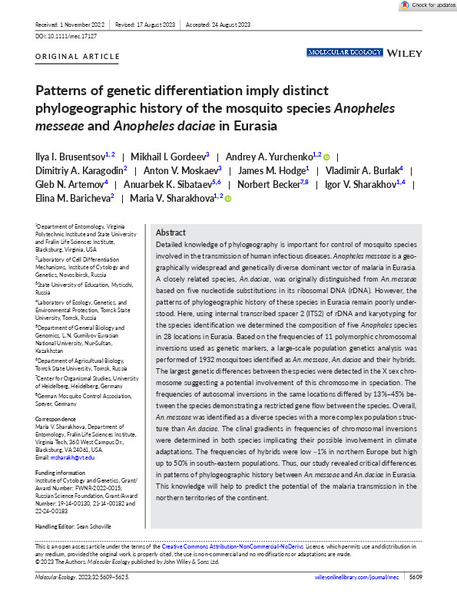
Detailed knowledge of phylogeography is important for control of mosquito species
involved in the transmission of human infectious diseases. Anopheles messeae is a geographically widespread and genetically diverse dominant vector of malaria in Eurasia.
A closely related species, An. daciae, was originally distinguished from An. messeae
based on five nucleotide substitutions in its ribosomal DNA (rDNA). However, the
patterns of phylogeographic history of these species in Eurasia remain poorly understood. Here, using internal transcribed spacer 2 (ITS2) of rDNA and karyotyping for
the species identification we determined the composition of five Anopheles species
in 28 locations in Eurasia. Based on the frequencies of 11 polymorphic chromosomal
inversions used as genetic markers, a large-scale population genetics analysis was
performed of 1932 mosquitoes identified as An. messeae, An. daciae and their hybrids.
The largest genetic differences between the species were detected in the X sex chromosome suggesting a potential involvement of this chromosome in speciation. The
frequencies of autosomal inversions in the same locations differed by 13%–45% between the species demonstrating a restricted gene flow between the species. Overall,
An. messeae was identified as a diverse species with a more complex population structure than An. daciae. The clinal gradients in frequencies of chromosomal inversions
were determined in both species implicating their possible involvement in climate
adaptations. The frequencies of hybrids were low ~1% in northern Europe but high
up to 50% in south-eastern populations. Thus, our study revealed critical differences
in patterns of phylogeographic history between An. messeae and An. daciae in Eurasia.
This knowledge will help to predict the potential of the malaria transmission in the
northern territories of the continent.