Репозиторий Dspace
Updating of language training content in Kazakhstan: implementation of new linguodidactic approaches
- Главная
- →
- Научные статьи
- →
- 01. Публикации в изданиях зарубежных стран
- →
- Arts and Humanities
- →
- Просмотр элемента
JavaScript is disabled for your browser. Some features of this site may not work without it.
Показать сокращенную информацию
| dc.contributor.author | Fahrutdinova, Guzaliya Zh. | |
| dc.contributor.author | Bulatbayeva, Kulzhanat N. | |
| dc.contributor.author | Kondratova, Olga I. | |
| dc.contributor.author | Fedorova, Svetlana N. | |
| dc.contributor.author | Petukhova, Olga A. | |
| dc.date.accessioned | 2024-09-19T06:06:24Z | |
| dc.date.available | 2024-09-19T06:06:24Z | |
| dc.date.issued | 2018 | |
| dc.identifier.issn | 1337-8384 | |
| dc.identifier.issn | 2453-711X | |
| dc.identifier.other | DOI: 10.18355/XL.2018.11.02.19 | |
| dc.identifier.uri | http://rep.enu.kz/handle/enu/16642 | |
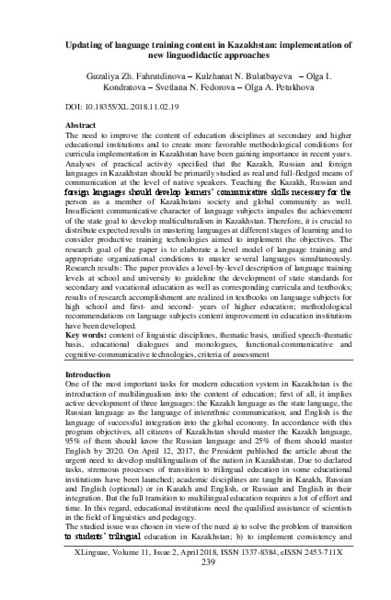
| dc.description.abstract | The need to improve the content of education disciplines at secondary and higher educational institutions and to create more favorable methodological conditions for curricula implementation in Kazakhstan have been gaining importance in recent years. Analyses of practical activity specified that the Kazakh, Russian and foreign languages in Kazakhstan should be primarily studied as real and full-fledged means of communication at the level of native speakers. Teaching the Kazakh, Russian and foreign languages should develop learners’ communicative skills necessary for the person as a member of Kazakhstani society and global community as well. Insufficient communicative character of language subjects impedes the achievement of the state goal to develop multiculturalism in Kazakhstan. Therefore, it is crucial to distribute expected results in mastering languages at different stages of learning and to consider productive training technologies aimed to implement the objectives. The research goal of the paper is to elaborate a level model of language training and appropriate organizational conditions to master several languages simultaneously. Research results: The paper provides a level-by-level description of language training levels at school and university to guideline the development of state standards for secondary and vocational education as well as corresponding curricula and textbooks; results of research accomplishment are realized in textbooks on language subjects for high school and first- and second- years of higher education; methodological recommendations on language subjects content improvement in education institutions have been developed. | ru |
| dc.language.iso | en | ru |
| dc.publisher | XLinguae | ru |
| dc.relation.ispartofseries | Volume 11, Issue 2;Pages 239 - 255 | |
| dc.subject | Content of linguistic disciplines | ru |
| dc.subject | Criteria of assessment | ru |
| dc.subject | Educational dialogues and monologues | ru |
| dc.subject | Functional-communicative and cognitive-communicative technologies | ru |
| dc.subject | Thematic basis | ru |
| dc.subject | Unified speech-thematic basis | ru |
| dc.title | Updating of language training content in Kazakhstan: implementation of new linguodidactic approaches | ru |
| dc.type | Article | ru |
Файлы в этом документе
Данный элемент включен в следующие коллекции
-
Arts and Humanities [150]