Репозиторий Dspace
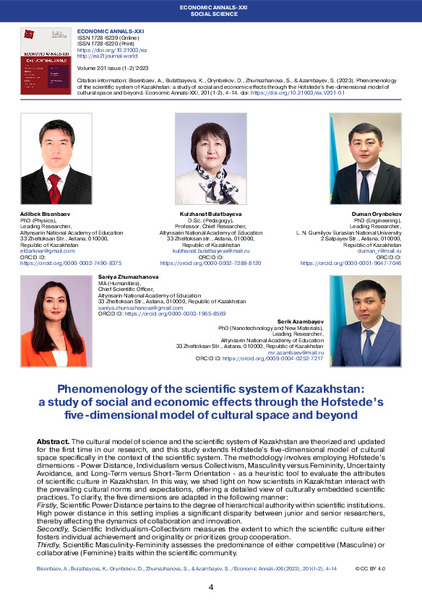
Phenomenology of the scientific system of Kazakhstan: a study of social and economic effects through the Hofstede’s five-dimensional model of cultural space and beyond
- Главная
- →
- Научные статьи
- →
- 01. Публикации в изданиях зарубежных стран
- →
- Economics, Econometrics and Finance
- →
- Просмотр элемента
JavaScript is disabled for your browser. Some features of this site may not work without it.
Показать сокращенную информацию
| dc.contributor.author | Bisenbaev, Adilbek | |
| dc.contributor.author | Bulatbayeva, Kulzhanat | |
| dc.contributor.author | Orynbekov, Duman | |
| dc.contributor.author | Zhumazhanova, Saniya | |
| dc.contributor.author | Azambayev, Serik | |
| dc.date.accessioned | 2024-09-24T11:55:36Z | |
| dc.date.available | 2024-09-24T11:55:36Z | |
| dc.date.issued | 2023 | |
| dc.identifier.issn | 1728-6220 | |
| dc.identifier.uri | http://rep.enu.kz/handle/enu/16923 | |
| dc.description.abstract | The cultural model of science and the scientific system of Kazakhstan are theorized and updated for the first time in our research, and this study extends Hofstede’s five-dimensional model of cultural space specifically in the context of the scientific system. The methodology involves employing Hofstede’s dimensions - Power Distance, Individualism versus Collectivism, Masculinity versus Femininity, Uncertainty Avoidance, and Long-Term versus Short-Term Orientation - as a heuristic tool to evaluate the attributes of scientific culture in Kazakhstan. In this way, we shed light on how scientists in Kazakhstan interact with the prevailing cultural norms and expectations, offering a detailed view of culturally embedded scientific practices. To clarify, the five dimensions are adapted in the following manner: Firstly, Scientific Power Distance pertains to the degree of hierarchical authority within scientific institutions. High power distance in this setting implies a significant disparity between junior and senior researchers, thereby affecting the dynamics of collaboration and innovation. Secondly, Scientific Individualism-Collectivism measures the extent to which the scientific culture either fosters individual achievement and originality or prioritizes group cooperation. Thirdly, Scientific Masculinity-Femininity assesses the predominance of either competitive (Masculine) or collaborative (Feminine) traits within the scientific community. Fourthly, Scientific Uncertainty Avoidance deals with the community’s tolerance for uncertainty and ambiguity, indicating whether there’s a preference for structured environments. Lastly, Scientific Long-Term Orientation gauges the focus of scientific endeavors, whether they aim for immediate outputs or invest in long-term research. The Kazakhstan scientific system is thus situated within this adapted framework of five dimensions, providing an intricate mapping of how cultural attributes impact scientific pursuits in the country. The importance of cultural phenomenology in the scientific domain comes from its focus on the observation and interpretation of the cultural factors that influence scientific thinking, progress, and implementation. It recognizes that science is not an isolated activity but is deeply entrenched in societal and cultural systems. In the specific context of Kazakhstan, a country experiencing rapid socio-economic changes, the scientific system is not only shaped by various facets of cultural identity but also makes substantial contributions to socio-economic development. Regarding the empirical findings of this study, the data illustrates the profound economic impact of the scientific system in Kazakhstan. From increased R&D investment to job creation and attracting significant Foreign Direct Investment (FDI), the scientific system appears to make a direct and meaningful contribution to the nation’s economic growth and development. In conclusion, these findings suggest that there is a positive trajectory for the scientific culture in Kazakhstan, contributing both to socio-economic conditions and to the global scientific community. | ru |
| dc.description.sponsorship | This paper was prepared within the Programme Trust Fund Study: OR 11465474 «Scientific foundations of modernization of the education system and science» (2021-2023, Altynsarin National Academy of Education). | ru |
| dc.language.iso | en | ru |
| dc.publisher | Economic Annals-XXI | ru |
| dc.relation.ispartofseries | Volume 201, Issue 1-2;Pages 4 - 14 | |
| dc.subject | Attribute | ru |
| dc.subject | Cultural Universals | ru |
| dc.subject | Culture | ru |
| dc.subject | Dimension | ru |
| dc.subject | Hofstede | ru |
| dc.subject | Kazakhstan | ru |
| dc.subject | Model | ru |
| dc.subject | Science | ru |
| dc.title | Phenomenology of the scientific system of Kazakhstan: a study of social and economic effects through the Hofstede’s five-dimensional model of cultural space and beyond | ru |
| dc.title.alternative | Феноменологія наукової системи Казахстану: дослідження соціально-економічних ефектів на онові адаптованої моделі культурного простору Хофстеде | ru |
| dc.type | Article | ru |