Репозиторий Dspace
Translation Techniques Used in Assassin Creed: Renaissance Novel
- Басты
- →
- Научные статьи
- →
- 01. Публикации в изданиях зарубежных стран
- →
- Environmental Science
- →
- Просмотр элемента
JavaScript is disabled for your browser. Some features of this site may not work without it.
Показать сокращенную информацию
| dc.contributor.author | Arbain | |
| dc.contributor.author | Nababan, Mangatur Rudolf | |
| dc.contributor.author | Santosa, Riyadi | |
| dc.contributor.author | Wiratno, Tri | |
| dc.date.accessioned | 2024-10-11T04:51:47Z | |
| dc.date.available | 2024-10-11T04:51:47Z | |
| dc.date.issued | 2022 | |
| dc.identifier.issn | 2281-46112 | |
| dc.identifier.other | doi.org/10.36941/ajis-2022-0076 | |
| dc.identifier.uri | http://rep.enu.kz/handle/enu/17647 | |
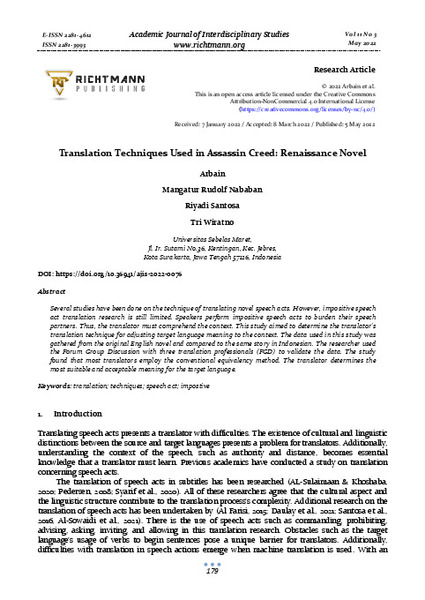
| dc.description.abstract | Several studies have been done on the technique of translating novel speech acts. However, impositive speech act translation research is still limited. Speakers perform impositive speech acts to burden their speech partners. Thus, the translator must comprehend the context. This study aimed to determine the translator's translation technique for adjusting target language meaning to the context. The data used in this study was gathered from the original English novel and compared to the same story in Indonesian. The researcher used the Forum Group Discussion with three translation professionals (FGD) to validate the data. The study found that most translators employ the conventional equivalency method. The translator determines the most suitable and acceptable meaning for the target language. | ru |
| dc.language.iso | en | ru |
| dc.publisher | Academic Journal of Interdisciplinary Studies | ru |
| dc.relation.ispartofseries | Vol 11 No 3; | |
| dc.subject | translation | ru |
| dc.subject | techniques | ru |
| dc.subject | speech act | ru |
| dc.subject | impostive | ru |
| dc.title | Translation Techniques Used in Assassin Creed: Renaissance Novel | ru |
| dc.type | Article | ru |
Файлы в этом документе
Данный элемент включен в следующие коллекции
-
Environmental Science [224]