Репозиторий Dspace
Ethanol production from cassava peels using Saccharomyces cerevisiae via ethanologenic fermentation process
- Басты
- →
- Научные статьи
- →
- 01. Публикации в изданиях зарубежных стран
- →
- Environmental Science
- →
- Просмотр элемента
JavaScript is disabled for your browser. Some features of this site may not work without it.
Показать сокращенную информацию
| dc.contributor.author | Adewale Allen, Sokan-Adeaga | |
| dc.contributor.author | Ana, Godson R.E.E. | |
| dc.contributor.author | Olorunnisola, Abel Olajide | |
| dc.contributor.author | Sokan-Adeaga, Micheal Ayodeji | |
| dc.contributor.author | Roy, Hridoy | |
| dc.contributor.author | Reza, Md Sumon | |
| dc.contributor.author | Islam, Md. Shahinoor | |
| dc.date.accessioned | 2024-10-11T11:20:11Z | |
| dc.date.available | 2024-10-11T11:20:11Z | |
| dc.date.issued | 2024 | |
| dc.identifier.issn | 19859899 | |
| dc.identifier.other | DOI 10.1108/AGJSR-06-2023-0264 | |
| dc.identifier.uri | http://rep.enu.kz/handle/enu/17688 | |
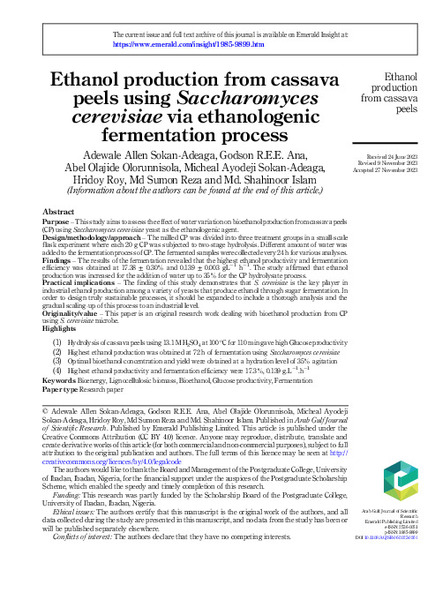
| dc.description.abstract | Purpose: This study aims to assess the effect of water variation on bioethanol production from cassava peels (CP) using Saccharomyces cerevisiae yeast as the ethanologenic agent. Design/methodology/approach: The milled CP was divided into three treatment groups in a small-scale flask experiment where each 20 g CP was subjected to two-stage hydrolysis. Different amount of water was added to the fermentation process of CP. The fermented samples were collected every 24 h for various analyses. Findings: The results of the fermentation revealed that the highest ethanol productivity and fermentation efficiency was obtained at 17.38 ± 0.30% and 0.139 ± 0.003 gL−1 h−1. The study affirmed that ethanol production was increased for the addition of water up to 35% for the CP hydrolysate process. Practical implications: The finding of this study demonstrates that S. cerevisiae is the key player in industrial ethanol production among a variety of yeasts that produce ethanol through sugar fermentation. In order to design truly sustainable processes, it should be expanded to include a thorough analysis and the gradual scaling-up of this process to an industrial level. Originality/value: This paper is an original research work dealing with bioethanol production from CP using S. cerevisiae microbe. Highlights: Hydrolysis of cassava peels using 13.1 M H2SO4 at 100 oC for 110 min gave high Glucose productivity Highest ethanol production was obtained at 72 h of fermentation using Saccharomyces cerevisiae Optimal bioethanol concentration and yield were obtained at a hydration level of 35% agitation Highest ethanol productivity and fermentation efficiency were 17.3%, 0.139 g.L−1.h−1 © 2023, Adewale Allen Sokan-Adeaga, Godson R.E.E. Ana, Abel Olajide Olorunnisola, Micheal Ayodeji Sokan-Adeaga, Hridoy Roy, Md Sumon Reza and Md. Shahinoor Islam. | ru |
| dc.language.iso | en | ru |
| dc.publisher | Arab Gulf Journal of Scientific Research | ru |
| dc.subject | Bioenergy | ru |
| dc.subject | Bioethanol | ru |
| dc.subject | Fermentation | ru |
| dc.subject | Glucose productivity | ru |
| dc.subject | Lignocellulosic biomass | ru |
| dc.title | Ethanol production from cassava peels using Saccharomyces cerevisiae via ethanologenic fermentation process | ru |
| dc.type | Article | ru |
Файлы в этом документе
Данный элемент включен в следующие коллекции
-
Environmental Science [224]