Репозиторий Dspace
Museal Indoor Air Quality and Public Health: An Integrated Approach for Exhibits Preservation and Ensuring Human Health
- Басты
- →
- Научные статьи
- →
- 01. Публикации в изданиях зарубежных стран
- →
- Environmental Science
- →
- Просмотр элемента
JavaScript is disabled for your browser. Some features of this site may not work without it.
Показать сокращенную информацию
| dc.contributor.author | Ilies, Dorina Camelia | |
| dc.contributor.author | Safarov, Bahodirhon | |
| dc.contributor.author | Caciora, Tudor | |
| dc.contributor.author | Ilies, Alexandru | |
| dc.contributor.author | Grama, Vasile | |
| dc.contributor.author | Ilies, Gabriela | |
| dc.contributor.author | Huniadi, Anca | |
| dc.contributor.author | Zharas, Berdenov | |
| dc.contributor.author | Hodor, Nicolaie | |
| dc.contributor.author | Sandor, Mircea | |
| dc.contributor.author | Zsarnóczky, Martin Balázs | |
| dc.contributor.author | Pantea, Emilia | |
| dc.contributor.author | Herman, Grigore Vasile | |
| dc.contributor.author | Dejeu, Paula | |
| dc.contributor.author | Szabo-Alex, Mariana | |
| dc.contributor.author | David, Lorant Denes | |
| dc.date.accessioned | 2024-10-17T04:14:07Z | |
| dc.date.available | 2024-10-17T04:14:07Z | |
| dc.date.issued | 2022 | |
| dc.identifier.issn | 2162-5689 | |
| dc.identifier.other | doi.org/10.3390/su14042462 | |
| dc.identifier.uri | http://rep.enu.kz/handle/enu/17827 | |
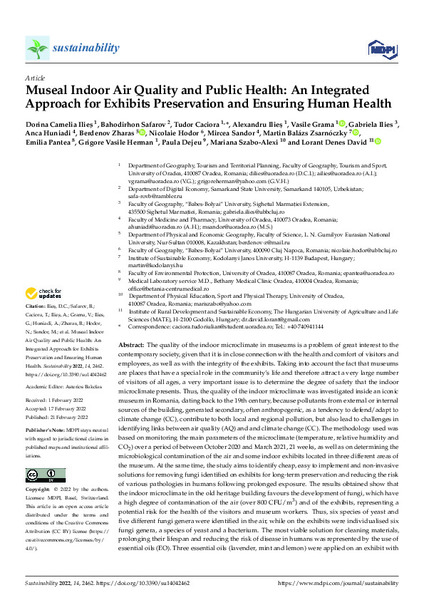
| dc.description.abstract | The quality of the indoor microclimate in museums is a problem of great interest to the contemporary society, given that it is in close connection with the health and comfort of visitors and employees, as well as with the integrity of the exhibits. Taking into account the fact that museums are places that have a special role in the community’s life and therefore attract a very large number of visitors of all ages, a very important issue is to determine the degree of safety that the indoor microclimate presents. Thus, the quality of the indoor microclimate was investigated inside an iconic museum in Romania, dating back to the 19th century, because pollutants from external or internal sources of the building, generated secondary, often anthropogenic, as a tendency to defend/adapt to climate change (CC), contribute to both local and regional pollution, but also lead to challenges in identifying links between air quality (AQ) and and climate change (CC). The methodology used was based on monitoring the main parameters of the microclimate (temperature, relative humidity and CO2 ) over a period of between October 2020 and March 2021, 21 weeks, as well as on determining the microbiological contamination of the air and some indoor exhibits located in three different areas of the museum. At the same time, the study aims to identify cheap, easy to implement and non-invasive solutions for removing fungi identified on exhibits for long-term preservation and reducing the risk of various pathologies in humans following prolonged exposure. The results obtained show that the indoor microclimate in the old heritage building favours the development of fungi, which have a high degree of contamination of the air (over 800 CFU/m3 ) and of the exhibits, representing a potential risk for the health of the visitors and museum workers. Thus, six species of yeast and five different fungi genera were identified in the air, while on the exhibits were individualised six fungi genera, a species of yeast and a bacterium. The most viable solution for cleaning materials, prolonging their lifespan and reducing the risk of disease in humans was represented by the use of essential oils (EO). Three essential oils (lavender, mint and lemon) were applied on an exhibit with The quality of the indoor microclimate in museums is a problem of great interest to the contemporary society, given that it is in close connection with the health and comfort of visitors and employees, as well as with the integrity of the exhibits. Taking into account the fact that museums are places that have a special role in the community’s life and therefore attract a very large number of visitors of all ages, a very important issue is to determine the degree of safety that the indoor microclimate presents. Thus, the quality of the indoor microclimate was investigated inside an iconic museum in Romania, dating back to the 19th century, because pollutants from external or internal sources of the building, generated secondary, often anthropogenic, as a tendency to defend/adapt to climate change (CC), contribute to both local and regional pollution, but also lead to challenges in identifying links between air quality (AQ) and and climate change (CC). The methodology used was based on monitoring the main parameters of the microclimate (temperature, relative humidity and CO2 ) over a period of between October 2020 and March 2021, 21 weeks, as well as on determining the microbiological contamination of the air and some indoor exhibits located in three different areas of the museum. At the same time, the study aims to identify cheap, easy to implement and non-invasive solutions for removing fungi identified on exhibits for long-term preservation and reducing the risk of various pathologies in humans following prolonged exposure. The results obtained show that the indoor microclimate in the old heritage building favours the development of fungi, which have a high degree of contamination of the air (over 800 CFU/m3 ) and of the exhibits, representing a potential risk for the health of the visitors and museum workers. Thus, six species of yeast and five different fungi genera were identified in the air, while on the exhibits were individualised six fungi genera, a species of yeast and a bacterium. The most viable solution for cleaning materials, prolonging their lifespan and reducing the risk of disease in humans was represented by the use of essential oils (EO). Three essential oils (lavender, mint and lemon) were applied on an exhibit with The quality of the indoor microclimate in museums is a problem of great interest to the contemporary society, given that it is in close connection with the health and comfort of visitors and employees, as well as with the integrity of the exhibits. Taking into account the fact that museums are places that have a special role in the community’s life and therefore attract a very large number of visitors of all ages, a very important issue is to determine the degree of safety that the indoor microclimate presents. Thus, the quality of the indoor microclimate was investigated inside an iconic museum in Romania, dating back to the 19th century, because pollutants from external or internal sources of the building, generated secondary, often anthropogenic, as a tendency to defend/adapt to climate change (CC), contribute to both local and regional pollution, but also lead to challenges in identifying links between air quality (AQ) and and climate change (CC). The methodology used was based on monitoring the main parameters of the microclimate (temperature, relative humidity and CO2 ) over a period of between October 2020 and March 2021, 21 weeks, as well as on determining the microbiological contamination of the air and some indoor exhibits located in three different areas of the museum. At the same time, the study aims to identify cheap, easy to implement and non-invasive solutions for removing fungi identified on exhibits for long-term preservation and reducing the risk of various pathologies in humans following prolonged exposure. The results obtained show that the indoor microclimate in the old heritage building favours the development of fungi, which have a high degree of contamination of the air (over 800 CFU/m3 ) and of the exhibits, representing a potential risk for the health of the visitors and museum workers. Thus, six species of yeast and five different fungi genera were identified in the air, while on the exhibits were individualised six fungi genera, a species of yeast and a bacterium. The most viable solution for cleaning materials, prolonging their lifespan and reducing the risk of disease in humans was represented by the use of essential oils (EO). Three essential oils (lavender, mint and lemon) were applied on an exhibit with The quality of the indoor microclimate in museums is a problem of great interest to the contemporary society, given that it is in close connection with the health and comfort of visitors and employees, as well as with the integrity of the exhibits. Taking into account the fact that museums are places that have a special role in the community’s life and therefore attract a very large number of visitors of all ages, a very important issue is to determine the degree of safety that the indoor microclimate presents. Thus, the quality of the indoor microclimate was investigated inside an iconic museum in Romania, dating back to the 19th century, because pollutants from external or internal sources of the building, generated secondary, often anthropogenic, as a tendency to defend/adapt to climate change (CC), contribute to both local and regional pollution, but also lead to challenges in identifying links between air quality (AQ) and and climate change (CC). The methodology used was based on monitoring the main parameters of the microclimate (temperature, relative humidity and CO2 ) over a period of between October 2020 and March 2021, 21 weeks, as well as on determining the microbiological contamination of the air and some indoor exhibits located in three different areas of the museum. At the same time, the study aims to identify cheap, easy to implement and non-invasive solutions for removing fungi identified on exhibits for long-term preservation and reducing the risk of various pathologies in humans following prolonged exposure. The results obtained show that the indoor microclimate in the old heritage building favours the development of fungi, which have a high degree of contamination of the air (over 800 CFU/m3 ) and of the exhibits, representing a potential risk for the health of the visitors and museum workers. Thus, six species of yeast and five different fungi genera were identified in the air, while on the exhibits were individualised six fungi genera, a species of yeast and a bacterium. The most viable solution for cleaning materials, prolonging their lifespan and reducing the risk of disease in humans was represented by the use of essential oils (EO). Three essential oils (lavender, mint and lemon) were applied on an exhibit with five different microorganism genera, and it was observed that they have the ability to inhibit the spores from moulds and bacteria, being a very good alternative to the usual chemical treatments that are used in the cultural heritage field. | ru |
| dc.language.iso | en | ru |
| dc.publisher | Sustainability | ru |
| dc.relation.ispartofseries | 14;2462 | |
| dc.subject | cultural heritage | ru |
| dc.subject | museum environment | ru |
| dc.subject | microaeroflora | ru |
| dc.subject | fungi | ru |
| dc.subject | essential oils | ru |
| dc.subject | antifungal | ru |
| dc.subject | antifungal | ru |
| dc.subject | cleaning | ru |
| dc.subject | public health | ru |
| dc.subject | human pathology | ru |
| dc.title | Museal Indoor Air Quality and Public Health: An Integrated Approach for Exhibits Preservation and Ensuring Human Health | ru |
| dc.type | Article | ru |
Файлы в этом документе
Данный элемент включен в следующие коллекции
-
Environmental Science [224]