Репозиторий Евразийского национального университета имени Л.Н. Гумилева
Просмотр элемента 
  •   Главная
  • Научные статьи
  • 01. Публикации в изданиях зарубежных стран
  • Environmental Science
  • Просмотр элемента
  •   Главная
  • Научные статьи
  • 01. Публикации в изданиях зарубежных стран
  • Environmental Science
  • Просмотр элемента
JavaScript is disabled for your browser. Some features of this site may not work without it.

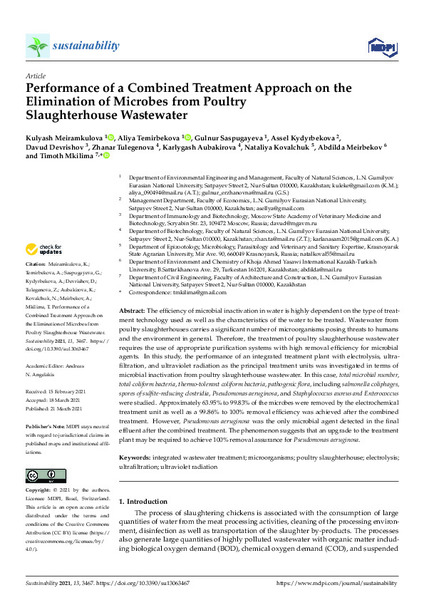
Performance of a Combined Treatment Approach on the Elimination of Microbes from Poultry Slaughterhouse Wastewater

Thumbnail
Автор
Meiramkulova, Kulyash
Temirbekova, Aliya
Saspugayeva, Gulnur
Kydyrbekova, Assel
Devrishov, Davud
Tulegenova, Zhanar
Aubakirova, Karlygash
Kovalchuk, Nataliya
Meirbekov, Abdilda
Mkilima, Timoth
Дата
2021
Редактор
Sustainability
ISSN
2162-5689
xmlui.dri2xhtml.METS-1.0.item-identifier-citation
Meiramkulova, K.; Temirbekova, A.; Saspugayeva, G.; Kydyrbekova, A.; Devrishov, D.; Tulegenova, Z.; Aubakirova, K.; Kovalchuk, N.; Meirbekov, A.; Mkilima, T. Performance of a Combined Treatment Approach on the Elimination of Microbes from Poultry Slaughterhouse Wastewater. Sustainability 2021, 13, 3467. https:// doi.org/10.3390/su13063467
Аннотации
The efficiency of microbial inactivation in water is highly dependent on the type of treatment technology used as well as the characteristics of the water to be treated. Wastewater from poultry slaughterhouses carries a significant number of microorganisms posing threats to humans and the environment in general. Therefore, the treatment of poultry slaughterhouse wastewater requires the use of appropriate purification systems with high removal efficiency for microbial agents. In this study, the performance of an integrated treatment plant with electrolysis, ultrafiltration, and ultraviolet radiation as the principal treatment units was investigated in terms of microbial inactivation from poultry slaughterhouse wastewater. In this case, total microbial number, total coliform bacteria, thermo-tolerant coliform bacteria, pathogenic flora, including salmonella coliphages, spores of sulfite-reducing clostridia, Pseudomonas aeruginosa, and Staphylococcus aureus and Enterococcus were studied. Approximately 63.95% to 99.83% of the microbes were removed by the electrochemical treatment unit as well as a 99.86% to 100% removal efficiency was achieved after the combined treatment. However, Pseudomonas aeruginosa was the only microbial agent detected in the final effluent after the combined treatment. The phenomenon suggests that an upgrade to the treatment plant may be required to achieve 100% removal assurance for Pseudomonas aeruginosa.
URI
http://rep.enu.kz/handle/enu/17839
Открыть
PERFOR~1.PDF (1.152Mb)
Collections
  • Environmental Science[350]
Показать полную информацию
CORE Recommender

Евразийский национальный университет имени Л.Н. Гумилева | Научная библиотека | Контакты
YM
Научная библиотека | Контакты
 

Просмотр

Весь DSpaceСообщества и коллекцииДата публикацииАвторыНазванияТематикаЭта коллекцияДата публикацииАвторыНазванияТематика

Моя учетная запись

ВойтиРегистрация

Евразийский национальный университет имени Л.Н. Гумилева | Научная библиотека | Контакты
YM
Научная библиотека | Контакты