Репозиторий Dspace
Sewage Sludge Management and Application in the Form of Sustainable Fertilizer
- Басты
- →
- Научные статьи
- →
- 01. Публикации в изданиях зарубежных стран
- →
- Environmental Science
- →
- Просмотр элемента
JavaScript is disabled for your browser. Some features of this site may not work without it.
Показать сокращенную информацию
| dc.contributor.author | Sugurbekova, Gulnar | |
| dc.contributor.author | Nagyzbekkyzy, Elvira | |
| dc.contributor.author | Sarsenova, Ainur | |
| dc.contributor.author | Danlybayeva, Gaziza | |
| dc.contributor.author | Anuarbekova, Sandugash | |
| dc.contributor.author | Kudaibergenova, Rabiga | |
| dc.contributor.author | Frochot, Céline | |
| dc.contributor.author | Acherar, Samir | |
| dc.contributor.author | Zhatkanbayev, Yerlan | |
| dc.contributor.author | Moldagulova, Nazira | |
| dc.date.accessioned | 2024-10-17T07:01:28Z | |
| dc.date.available | 2024-10-17T07:01:28Z | |
| dc.date.issued | 2023 | |
| dc.identifier.issn | 2162-5689 | |
| dc.identifier.other | doi.org/10.3390/su15076112 | |
| dc.identifier.uri | http://rep.enu.kz/handle/enu/17864 | |
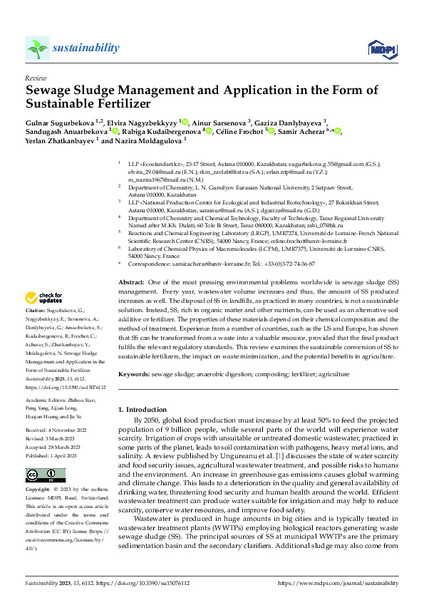
| dc.description.abstract | One of the most pressing environmental problems worldwide is sewage sludge (SS) management. Every year, wastewater volume increases and thus, the amount of SS produced increases as well. The disposal of SS in landfills, as practiced in many countries, is not a sustainable solution. Instead, SS, rich in organic matter and other nutrients, can be used as an alternative soil additive or fertilizer. The properties of these materials depend on their chemical composition and the method of treatment. Experience from a number of countries, such as the US and Europe, has shown that SS can be transformed from a waste into a valuable resource, provided that the final product fulfils the relevant regulatory standards. This review examines the sustainable conversion of SS to sustainable fertilizers, the impact on waste minimization, and the potential benefits in agriculture. | ru |
| dc.language.iso | en | ru |
| dc.publisher | Sustainability | ru |
| dc.relation.ispartofseries | 15;6112 | |
| dc.subject | sewage sludge | ru |
| dc.subject | anaerobic digestion | ru |
| dc.subject | composting | ru |
| dc.subject | fertilizer | ru |
| dc.subject | agriculture | ru |
| dc.title | Sewage Sludge Management and Application in the Form of Sustainable Fertilizer | ru |
| dc.type | Article | ru |
Файлы в этом документе
Данный элемент включен в следующие коллекции
-
Environmental Science [224]