DSpace Repository
The Effect of Mixing Ratios on the Performance of an Integrated Poultry Slaughterhouse Wastewater Treatment Plant for a Recyclable High-Quality Effluent
JavaScript is disabled for your browser. Some features of this site may not work without it.
| dc.contributor.author | Meiramkulova, Kulyash | |
| dc.contributor.author | Orynbekov, Duman | |
| dc.contributor.author | Saspugayeva, Gulnur | |
| dc.contributor.author | Aubakirova, Karlygash | |
| dc.contributor.author | Arystanova, Sholpan | |
| dc.contributor.author | Kydyrbekova, Aliya | |
| dc.contributor.author | Tashenov, Erbolat | |
| dc.contributor.author | Nurlan, Kartjanov | |
| dc.contributor.author | Mkilima, Timoth | |
| dc.date.accessioned | 2024-10-17T10:06:43Z | |
| dc.date.available | 2024-10-17T10:06:43Z | |
| dc.date.issued | 2020 | |
| dc.identifier.issn | 2162-5689 | |
| dc.identifier.uri | http://rep.enu.kz/handle/enu/17897 | |
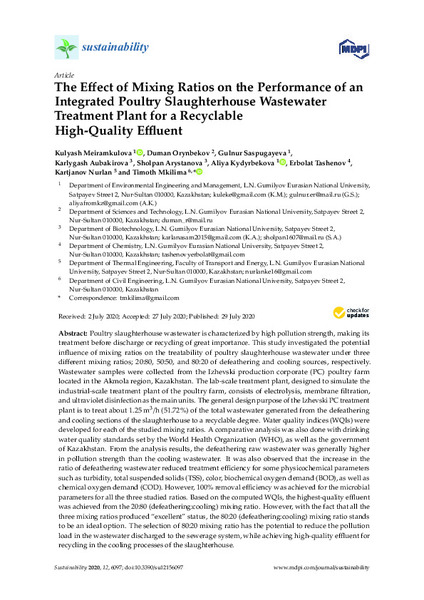
| dc.description.abstract | Poultry slaughterhouse wastewater is characterized by high pollution strength, making its treatment before discharge or recycling of great importance. This study investigated the potential influence of mixing ratios on the treatability of poultry slaughterhouse wastewater under three different mixing ratios; 20:80, 50:50, and 80:20 of defeathering and cooling sources, respectively. Wastewater samples were collected from the Izhevski production corporate (PC) poultry farm located in the Akmola region, Kazakhstan. The lab-scale treatment plant, designed to simulate the industrial-scale treatment plant of the poultry farm, consists of electrolysis, membrane filtration, and ultraviolet disinfection as the main units. The general design purpose of the Izhevski PC treatment plant is to treat about 1.25 m3 /h (51.72%) of the total wastewater generated from the defeathering and cooling sections of the slaughterhouse to a recyclable degree. Water quality indices (WQIs) were developed for each of the studied mixing ratios. A comparative analysis was also done with drinking water quality standards set by the World Health Organization (WHO), as well as the government of Kazakhstan. From the analysis results, the defeathering raw wastewater was generally higher in pollution strength than the cooling wastewater. It was also observed that the increase in the ratio of defeathering wastewater reduced treatment efficiency for some physicochemical parameters such as turbidity, total suspended solids (TSS), color, biochemical oxygen demand (BOD), as well as chemical oxygen demand (COD). However, 100% removal efficiency was achieved for the microbial parameters for all the three studied ratios. Based on the computed WQIs, the highest-quality effluent was achieved from the 20:80 (defeathering:cooling) mixing ratio. However, with the fact that all the three mixing ratios produced “excellent” status, the 80:20 (defeathering:cooling) mixing ratio stands to be an ideal option. The selection of 80:20 mixing ratio has the potential to reduce the pollution load in the wastewater discharged to the sewerage system, while achieving high-quality effluent for recycling in the cooling processes of the slaughterhouse. | ru |
| dc.language.iso | en | ru |
| dc.publisher | Sustainability | ru |
| dc.relation.ispartofseries | 12;6097 | |
| dc.subject | defeathering | ru |
| dc.subject | cooling | ru |
| dc.subject | mixing ratio | ru |
| dc.subject | poultry slaughterhouse | ru |
| dc.subject | wastewater treatment | ru |
| dc.title | The Effect of Mixing Ratios on the Performance of an Integrated Poultry Slaughterhouse Wastewater Treatment Plant for a Recyclable High-Quality Effluent | ru |
| dc.type | Article | ru |
Files in this item
This item appears in the following Collection(s)
-
Environmental Science [224]