DSpace Repository
Features of word formation of new vocabulary in English
- DSpace Home
- →
- Научные статьи
- →
- 01. Публикации в изданиях зарубежных стран
- →
- Social Sciences
- →
- View Item
JavaScript is disabled for your browser. Some features of this site may not work without it.
| dc.contributor.author | Shokhayeva, Karlygash | |
| dc.contributor.author | Auyelbekova, Akmarzhan | |
| dc.contributor.author | Shomanova, Gulnar | |
| dc.contributor.author | Dutbayeva, Saule | |
| dc.contributor.author | Zhapanova, Marzhan | |
| dc.date.accessioned | 2024-10-23T11:11:16Z | |
| dc.date.available | 2024-10-23T11:11:16Z | |
| dc.date.issued | 2023 | |
| dc.identifier.issn | 2453-711X | |
| dc.identifier.other | DOI: 10.18355/XL.2023.16.01.11 | |
| dc.identifier.uri | http://rep.enu.kz/handle/enu/18323 | |
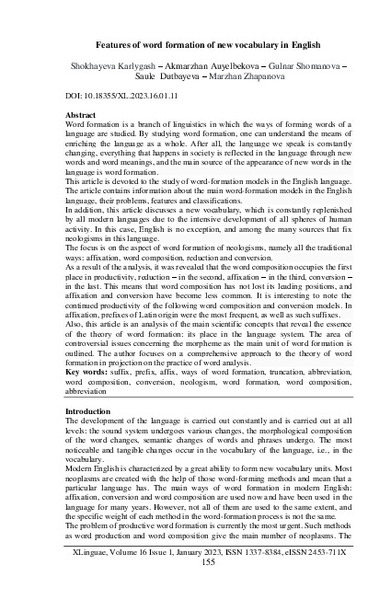
| dc.description.abstract | Word formation is a branch of linguistics in which the ways of forming words of a language are studied. By studying word formation, one can understand the means of enriching the language as a whole. After all, the language we speak is constantly changing, everything that happens in society is reflected in the language through new words and word meanings, and the main source of the appearance of new words in the language is word formation. This article is devoted to the study of word-formation models in the English language. The article contains information about the main word-formation models in the English language, their problems, features and classifications. In addition, this article discusses a new vocabulary, which is constantly replenished by all modern languages due to the intensive development of all spheres of human activity. In this case, English is no exception, and among the many sources that fix neologisms in this language. The focus is on the aspect of word formation of neologisms, namely all the traditional ways: affixation, word composition, reduction and conversion. As a result of the analysis, it was revealed that the word composition occupies the first place in productivity, reduction – in the second, affixation – in the third, conversion – in the last. This means that word composition has not lost its leading positions, and affixation and conversion have become less common. It is interesting to note the continued productivity of the following word composition and conversion models. In affixation, prefixes of Latin origin were the most frequent, as well as such suffixes. Also, this article is an analysis of the main scientific concepts that reveal the essence of the theory of word formation: its place in the language system. The area of controversial issues concerning the morpheme as the main unit of word formation is outlined. The author focuses on a comprehensive approach to the theory of word formation in projection on the practice of word analysis. | ru |
| dc.language.iso | en | ru |
| dc.publisher | XLinguae | ru |
| dc.relation.ispartofseries | Volume 16 Issue 1; | |
| dc.subject | suffix | ru |
| dc.subject | prefix | ru |
| dc.subject | affix | ru |
| dc.subject | ways of word formation | ru |
| dc.subject | truncation | ru |
| dc.subject | abbreviation | ru |
| dc.subject | word composition | ru |
| dc.subject | conversion | ru |
| dc.subject | neologism | ru |
| dc.subject | word formation | ru |
| dc.subject | word composition | ru |
| dc.subject | abbreviation | ru |
| dc.title | Features of word formation of new vocabulary in English | ru |
| dc.type | Article | ru |
Files in this item
This item appears in the following Collection(s)
-
Social Sciences [759]