Репозиторий Dspace
Manipulation as a rhetorical argument in Chekhov’s poetics
- Басты
- →
- Научные статьи
- →
- 01. Публикации в изданиях зарубежных стран
- →
- Social Sciences
- →
- Просмотр элемента
JavaScript is disabled for your browser. Some features of this site may not work without it.
Показать сокращенную информацию
| dc.date.accessioned | 2024-11-01T04:50:49Z | |
| dc.date.available | 2024-11-01T04:50:49Z | |
| dc.date.issued | 2021 | |
| dc.identifier.citation | Urazayeva K.B., Azkenova Zh.K. Manipulation as a rhetorical argument in Chekhov’s poetics. Vestnik of Saint Petersburg University. Language and Literature. 2021, 18 (2): 298–312. https://doi.org/10.21638/spbu09.2021.204 (In Russian) | ru |
| dc.identifier.issn | 2541-9358 | |
| dc.identifier.other | doi.org/10.21638/spbu09.2021.204 | |
| dc.identifier.uri | http://rep.enu.kz/handle/enu/18392 | |
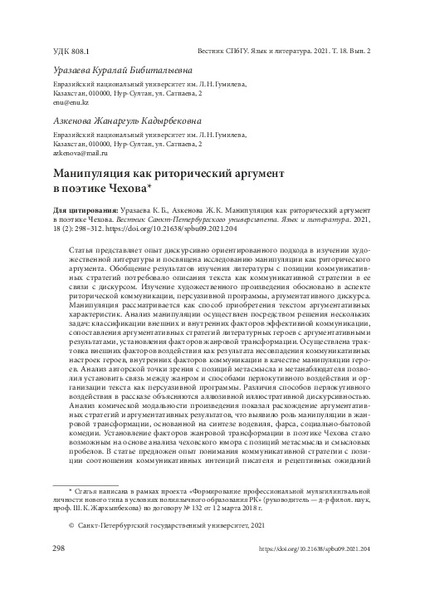
| dc.description.abstract | The article presents the experience of a discursive-oriented approach in the study of works of fiction and is devoted to the study of manipulation as a rhetorical argument. Summarizing the results of studying literature from the perspective of communicative strategies required describing the text as a communicative strategy in its connection with discourse. The analysis of manipulation is carried out by means of solving problems: classification of external and internal factors of effective communication, comparison of argumentative strategies of literary characters with argumentative results, and the establishment of factors of genre transformation. The interpretation of external factors of influence as a result of the disparity of communicative settings of heroes, and internal factors of communication as manipulation of heroes is conducted in the article. The analysis of the author’s point of view from the positions of metasense and meta-observer allowed the authors of the article to establish a connection between the genre and the methods of perlocative influence and the organization of the text as a pervasive program. The differences in the methods of perlocative influence in the story are explained by allusive illustrative discursivity. The analysis of the comic modality of the work showed a discrepancy between argumentative strategies and argumentative results, which revealed the role of manipulation in the genre transformation based on the synthesis of vaudeville, farce, and social сomedy. The establishment of factors of genre transformation in Chekhov’s poetics became possible on the basis of the analysis of Chekhov’s humor from the positions of metasense and semantic gaps. | ru |
| dc.language.iso | en | ru |
| dc.publisher | Vestnik of Saint Petersburg University. Language and Literature | ru |
| dc.relation.ispartofseries | 18 (2): 298–312; | |
| dc.subject | Chekhov | ru |
| dc.subject | manipulation | ru |
| dc.subject | manipulation | ru |
| dc.subject | rhetorical argument | ru |
| dc.subject | A Problem | ru |
| dc.subject | A Marriage Proposal | ru |
| dc.title | Manipulation as a rhetorical argument in Chekhov’s poetics | ru |
| dc.title.alternative | Манипуляция как риторический аргумент в поэтике Чехова | ru |
| dc.type | Article | ru |
Файлы в этом документе
Данный элемент включен в следующие коллекции
-
Social Sciences [759]