Репозиторий Dspace
Analysis of the influence of thermal insulation material on the thermal resistance of new facade structures with horizontal air channels
- Главная
- →
- Научные статьи
- →
- 01. Публикации в изданиях зарубежных стран
- →
- Materials Science
- →
- Просмотр элемента
JavaScript is disabled for your browser. Some features of this site may not work without it.
Показать сокращенную информацию
| dc.contributor.author | Zhangabay, Nurlan | |
| dc.contributor.author | Tagybayev, Askhat | |
| dc.contributor.author | Utelbayeva, Akmaral | |
| dc.contributor.author | Buganova, Svetlana | |
| dc.contributor.author | Tolganbayev, Akzhan | |
| dc.contributor.author | Tulesheva, Gulnara | |
| dc.contributor.author | Jumabayev, Atogali | |
| dc.contributor.author | Kolesnikov, Alexandr | |
| dc.contributor.author | Kambarov, Medetbek | |
| dc.contributor.author | Imanaliyev, Kuanysh | |
| dc.contributor.author | Kozlov, Pavel | |
| dc.date.accessioned | 2024-12-25T07:32:18Z | |
| dc.date.available | 2024-12-25T07:32:18Z | |
| dc.date.issued | 2023 | |
| dc.identifier.issn | 2214-5095 | |
| dc.identifier.other | doi.org/10.1016/j.cscm.2023.e02026 | |
| dc.identifier.uri | http://rep.enu.kz/handle/enu/20368 | |
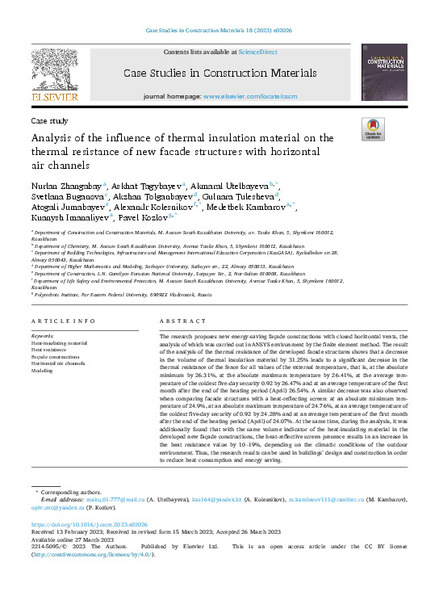
| dc.description.abstract | The research proposes new energy-saving façade constructions with closed horizontal vents, the analysis of which was carried out in ANSYS environment by the finite element method. The result of the analysis of the thermal resistance of the developed facade structures shows that a decrease in the volume of thermal insulation material by 31.25% leads to a significant decrease in the thermal resistance of the fence for all values of the external temperature, that is, at the absolute minimum by 26.31%, at the absolute maximum temperature by 26.41%, at the average tem perature of the coldest five-day security 0.92 by 26.47% and at an average temperature of the first month after the end of the heating period (April) 26.54%. A similar decrease was also observed when comparing facade structures with a heat-reflecting screen: at an absolute minimum tem perature of 24.9%, at an absolute maximum temperature of 24.76%, at an average temperature of the coldest five-day security of 0.92 by 24.28% and at an average temperature of the first month after the end of the heating period (April) of 24.07%. At the same time, during the analysis, it was additionally found that with the same volume indicator of the heat-insulating material in the developed new façade constructions, the heat-reflective screen presence results in an increase in the heat resistance value by 10–19%, depending on the climatic conditions of the outdoor environment. Thus, the research results can be used in buildings’ design and construction in order to reduce heat consumption and energy saving. | ru |
| dc.language.iso | en | ru |
| dc.publisher | Case Studies in Construction Materials | ru |
| dc.relation.ispartofseries | 18 (2023) e02026; | |
| dc.subject | Heat-insulating material | ru |
| dc.subject | Heat resistance | ru |
| dc.subject | Façade constructions | ru |
| dc.subject | Horizontal air channels | ru |
| dc.subject | Modeling | ru |
| dc.title | Analysis of the influence of thermal insulation material on the thermal resistance of new facade structures with horizontal air channels | ru |
| dc.type | Article | ru |
| dc.type | Book | ru |
Файлы в этом документе
Данный элемент включен в следующие коллекции
-
Materials Science [334]