Репозиторий Dspace
SRIM Simulation of Carbon Ions Interaction with Ni Nanotubes
- Главная
- →
- Научные статьи
- →
- 01. Публикации в изданиях зарубежных стран
- →
- Materials Science
- →
- Просмотр элемента
JavaScript is disabled for your browser. Some features of this site may not work without it.
Показать сокращенную информацию
| dc.contributor.author | Kaniukov, E. | |
| dc.contributor.author | Kutuzau, M. | |
| dc.contributor.author | Bundyukova, V. | |
| dc.contributor.author | Yakimchuk, D. | |
| dc.contributor.author | Kozlovskiy, A. | |
| dc.contributor.author | Borgekov, D. | |
| dc.contributor.author | Zdorovets, M. | |
| dc.contributor.author | Shlimas, D. | |
| dc.contributor.author | Shumskaya, A. | |
| dc.date.accessioned | 2024-12-25T09:41:18Z | |
| dc.date.available | 2024-12-25T09:41:18Z | |
| dc.date.issued | 2019 | |
| dc.identifier.issn | 2214-5095 | |
| dc.identifier.uri | http://rep.enu.kz/handle/enu/20379 | |
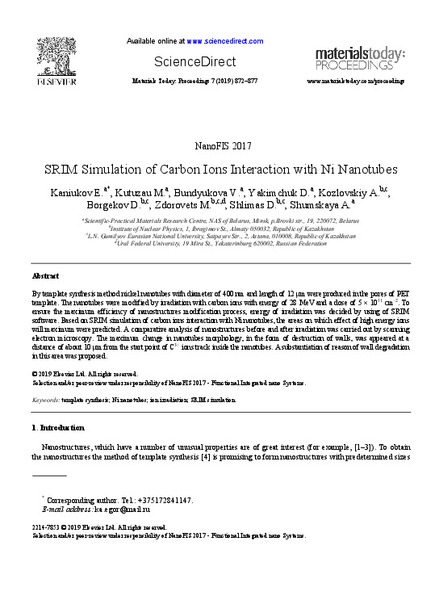
| dc.description.abstract | By template synthesis method nickel nanotubes with diameter of 400 nm and length of 12 μm were produced in the pores of PET template. The nanotubes were modified by irradiation with carbon ions with energy of 28 MeV and a dose of 5 × 1011 cm-2. To ensure the maximum efficiency of nanostructures modification process, energy of irradiation was decided by using of SRIM software. Based on SRIM simulation of carbon ions interaction with Ni nanotubes, the areas on which effect of high energy ions will maximum were predicted. A comparative analysis of nanostructures before and after irradiation was carried out by scanning electron microscopy. The maximum change in nanotubes morphology, in the form of destruction of walls, was appeared at a distance of about 10 μm from the start point of C3+ ions track inside the nanotubes. A substantiation of reason of wall degradation in this area was proposed. | ru |
| dc.language.iso | en | ru |
| dc.publisher | Materials Today: Proceedings 7 (2019) 872–877 | ru |
| dc.relation.ispartofseries | 7 (2019) 872–877; | |
| dc.subject | template synthesis | ru |
| dc.subject | Ni nanotubes | ru |
| dc.subject | ion irradiation | ru |
| dc.subject | SRIM simulation | ru |
| dc.title | SRIM Simulation of Carbon Ions Interaction with Ni Nanotubes | ru |
| dc.type | Article | ru |
Файлы в этом документе
Данный элемент включен в следующие коллекции
-
Materials Science [334]