DSpace Repository
Clustering of Diamond Nanoparticles, Fluorination and Efficiency of Slow Neutron Reflectors
- DSpace Home
- →
- Научные статьи
- →
- 01. Публикации в изданиях зарубежных стран
- →
- Materials Science
- →
- View Item
JavaScript is disabled for your browser. Some features of this site may not work without it.
| dc.contributor.author | Aleksenskii, Aleksander | |
| dc.contributor.author | Bleuel, Markus | |
| dc.contributor.author | Bosak, Alexei | |
| dc.contributor.author | Chumakova, Alexandra | |
| dc.contributor.author | Dideikin, Artur | |
| dc.contributor.author | Dubois, Marc | |
| dc.contributor.author | Korobkina, Ekaterina | |
| dc.contributor.author | Lychagin, Egor | |
| dc.contributor.author | Muzychka, Alexei | |
| dc.contributor.author | Nekhaev, Grigory | |
| dc.contributor.author | Nesvizhevsky, Valery | |
| dc.contributor.author | Nezvanov, Alexander | |
| dc.contributor.author | Schweins, Ralf | |
| dc.contributor.author | Shvidchenko, Alexander | |
| dc.contributor.author | Strelkov, Alexander | |
| dc.contributor.author | Turlybekuly, Kylyshbek | |
| dc.contributor.author | Vul’, Alexander | |
| dc.contributor.author | Zhernenkov, Kirill | |
| dc.date.accessioned | 2024-12-26T06:27:02Z | |
| dc.date.available | 2024-12-26T06:27:02Z | |
| dc.date.issued | 2021 | |
| dc.identifier.citation | Aleksenskii, A.; Bleuel, M.; Bosak, A.; Chumakova, A.; Dideikin, A.; Dubois, M.; Korobkina, E.; Lychagin, E.; Muzychka, A.; Nekhaev, G.; et al. Clustering of Diamond Nanoparticles, Fluorination and Efficiency of Slow Neutron Reflectors. Nanomaterials 2021, 11, 1945. https:// doi.org/10.3390/nano11081945 | ru |
| dc.identifier.issn | 2079-4991 | |
| dc.identifier.other | doi.org/10.3390/nano11081945 | |
| dc.identifier.uri | http://rep.enu.kz/handle/enu/20434 | |
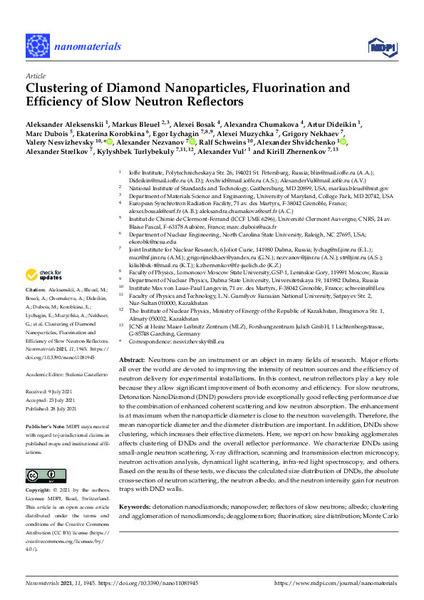
| dc.description.abstract | Neutrons can be an instrument or an object in many fields of research. Major efforts all over the world are devoted to improving the intensity of neutron sources and the efficiency of neutron delivery for experimental installations. In this context, neutron reflectors play a key role because they allow significant improvement of both economy and efficiency. For slow neutrons, Detonation NanoDiamond (DND) powders provide exceptionally good reflecting performance due to the combination of enhanced coherent scattering and low neutron absorption. The enhancement is at maximum when the nanoparticle diameter is close to the neutron wavelength. Therefore, the mean nanoparticle diameter and the diameter distribution are important. In addition, DNDs show clustering, which increases their effective diameters. Here, we report on how breaking agglomerates affects clustering of DNDs and the overall reflector performance. We characterize DNDs using small-angle neutron scattering, X-ray diffraction, scanning and transmission electron microscopy, neutron activation analysis, dynamical light scattering, infra-red light spectroscopy, and others. Based on the results of these tests, we discuss the calculated size distribution of DNDs, the absolute cross-section of neutron scattering, the neutron albedo, and the neutron intensity gain for neutron traps with DND walls. | ru |
| dc.language.iso | en | ru |
| dc.publisher | Nanomaterials | ru |
| dc.relation.ispartofseries | 11, 1945; | |
| dc.subject | detonation nanodiamonds | ru |
| dc.subject | nanopowder | ru |
| dc.subject | reflectors of slow neutrons | ru |
| dc.subject | albedo | ru |
| dc.subject | clustering and agglomeration of nanodiamonds | ru |
| dc.subject | deagglomeration | ru |
| dc.subject | fluorination | ru |
| dc.subject | size distribution | ru |
| dc.subject | Monte Carlo | ru |
| dc.title | Clustering of Diamond Nanoparticles, Fluorination and Efficiency of Slow Neutron Reflectors | ru |
| dc.type | Article | ru |
Files in this item
This item appears in the following Collection(s)
-
Materials Science [334]