Репозиторий Dspace
Effects of Structural Radiation Disorder in the Near-Surface Layer of Alloys Based on NbTiVZr Compounds Depending on the Variation of Alloy Components
- Главная
- →
- Научные статьи
- →
- 01. Публикации в изданиях зарубежных стран
- →
- Materials Science
- →
- Просмотр элемента
JavaScript is disabled for your browser. Some features of this site may not work without it.
Показать сокращенную информацию
| dc.contributor.author | Giniyatova, Sholpan G. | |
| dc.contributor.author | Kadyrzhanov, Kayrat K. | |
| dc.contributor.author | Shlimas, Dmitriy I. | |
| dc.contributor.author | Borgekov, Daryn B. | |
| dc.contributor.author | Uglov, Vladimir V. | |
| dc.contributor.author | Kozlovskiy, Artem L. | |
| dc.contributor.author | Zdorovets, Maxim V. | |
| dc.date.accessioned | 2024-12-26T11:11:19Z | |
| dc.date.available | 2024-12-26T11:11:19Z | |
| dc.date.issued | 2023 | |
| dc.identifier.issn | 2073-4352 | |
| dc.identifier.other | doi.org/10.3390/cryst13111543 | |
| dc.identifier.uri | http://rep.enu.kz/handle/enu/20480 | |
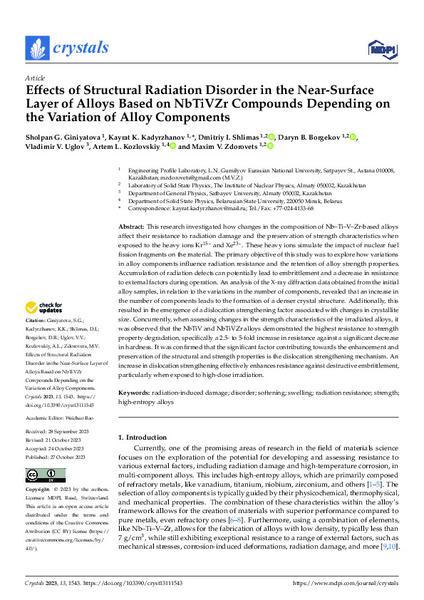
| dc.description.abstract | This research investigated how changes in the composition of Nb–Ti–V–Zr-based alloys affect their resistance to radiation damage and the preservation of strength characteristics when exposed to the heavy ions Kr15+ and Xe23+. These heavy ions simulate the impact of nuclear fuel fission fragments on the material. The primary objective of this study was to explore how variations in alloy components influence radiation resistance and the retention of alloy strength properties. Accumulation of radiation defects can potentially lead to embrittlement and a decrease in resistance to external factors during operation. An analysis of the X-ray diffraction data obtained from the initial alloy samples, in relation to the variations in the number of components, revealed that an increase in the number of components leads to the formation of a denser crystal structure. Additionally, this resulted in the emergence of a dislocation strengthening factor associated with changes in crystallite size. Concurrently, when assessing changes in the strength characteristics of the irradiated alloys, it was observed that the NbTiV and NbTiVZr alloys demonstrated the highest resistance to strength property degradation, specifically a 2.5- to 5-fold increase in resistance against a significant decrease in hardness. It was confirmed that the significant factor contributing towards the enhancement and preservation of the structural and strength properties is the dislocation strengthening mechanism. An increase in dislocation strengthening effectively enhances resistance against destructive embrittlement, particularly when exposed to high-dose irradiation. | ru |
| dc.language.iso | en | ru |
| dc.publisher | Crystals | ru |
| dc.subject | radiation-induced damage | ru |
| dc.subject | disorder; softening | ru |
| dc.subject | swelling | ru |
| dc.subject | radiation resistance | ru |
| dc.subject | strength | ru |
| dc.subject | high-entropy alloys | ru |
| dc.title | Effects of Structural Radiation Disorder in the Near-Surface Layer of Alloys Based on NbTiVZr Compounds Depending on the Variation of Alloy Components | ru |
| dc.type | Article | ru |
Файлы в этом документе
Данный элемент включен в следующие коллекции
-
Materials Science [334]