Репозиторий Dspace
Electrochemical Behaviour of Ti/Al2O3/Ni Nanocomposite Material in Artificial Physiological Solution: Prospects for Biomedical Application
- Главная
- →
- Научные статьи
- →
- 01. Публикации в изданиях зарубежных стран
- →
- Materials Science
- →
- Просмотр элемента
JavaScript is disabled for your browser. Some features of this site may not work without it.
Показать сокращенную информацию
| dc.contributor.author | Vorobjova, Alla | |
| dc.contributor.author | Tishkevich, Daria | |
| dc.contributor.author | Shimanovich, Dmitriy | |
| dc.contributor.author | Zdorovets, Maxim | |
| dc.contributor.author | Kozlovskiy, Artem | |
| dc.contributor.author | Zubar, Tatiana | |
| dc.contributor.author | Vinnik, Denis | |
| dc.contributor.author | Dong, Mengge | |
| dc.contributor.author | Trukhanov, Sergey | |
| dc.contributor.author | Trukhanov, Alex | |
| dc.contributor.author | Fedosyuk, Valery | |
| dc.date.accessioned | 2024-12-27T04:21:59Z | |
| dc.date.available | 2024-12-27T04:21:59Z | |
| dc.date.issued | 2020 | |
| dc.identifier.other | doi:10.3390/nano10010173 | |
| dc.identifier.uri | http://rep.enu.kz/handle/enu/20483 | |
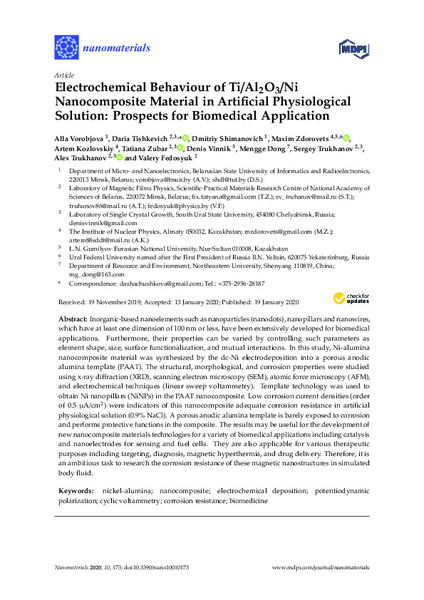
| dc.description.abstract | Inorganic-based nanoelements such as nanoparticles (nanodots), nanopillars and nanowires, which have at least one dimension of 100 nm or less, have been extensively developed for biomedical applications. Furthermore, their properties can be varied by controlling such parameters as element shape, size, surface functionalization, and mutual interactions. In this study, Ni-alumina nanocomposite material was synthesized by the dc-Ni electrodeposition into a porous anodic alumina template (PAAT). The structural, morphological, and corrosion properties were studied using x-ray diffraction (XRD), scanning electron microscopy (SEM), atomic force microscopy (AFM), and electrochemical techniques (linear sweep voltammetry). Template technology was used to obtain Ni nanopillars (NiNPs) in the PAAT nanocomposite. Low corrosion current densities (order of 0.5 µA/cm2 ) were indicators of this nanocomposite adequate corrosion resistance in artificial physiological solution (0.9% NaCl). A porous anodic alumina template is barely exposed to corrosion and performs protective functions in the composite. The results may be useful for the development of new nanocomposite materials technologies for a variety of biomedical applications including catalysis and nanoelectrodes for sensing and fuel cells. They are also applicable for various therapeutic purposes including targeting, diagnosis, magnetic hyperthermia, and drug delivery. Therefore, it is an ambitious task to research the corrosion resistance of these magnetic nanostructures in simulated body fluid. | ru |
| dc.language.iso | en | ru |
| dc.publisher | Nanomaterials | ru |
| dc.relation.ispartofseries | 10, 173; | |
| dc.subject | nickel-alumina | ru |
| dc.subject | nanocomposite | ru |
| dc.subject | electrochemical deposition | ru |
| dc.subject | potentiodynamic polarization | ru |
| dc.subject | cyclic voltammetry | ru |
| dc.subject | corrosion resistance | ru |
| dc.subject | biomedicine | ru |
| dc.title | Electrochemical Behaviour of Ti/Al2O3/Ni Nanocomposite Material in Artificial Physiological Solution: Prospects for Biomedical Application | ru |
| dc.type | Article | ru |
Файлы в этом документе
Данный элемент включен в следующие коллекции
-
Materials Science [334]