
Показать сокращенную информацию
Recent Developments of TiO2-Based Photocatalysis in the Hydrogen Evolution and Photodegradation: A Review
| dc.contributor.author | Bakbolat, Baglan | |
| dc.contributor.author | Daulbayev, Chingis | |
| dc.contributor.author | Sultanov, Fail | |
| dc.contributor.author | Beissenov, Renat | |
| dc.contributor.author | Umirzakov, Arman | |
| dc.contributor.author | Mereke, Almaz | |
| dc.contributor.author | Bekbaev, Askhat | |
| dc.contributor.author | Chuprakov, Igor | |
| dc.date.accessioned | 2025-01-05T09:15:23Z | |
| dc.date.available | 2025-01-05T09:15:23Z | |
| dc.date.issued | 2020 | |
| dc.identifier.issn | 2079-4991 | |
| dc.identifier.other | doi:10.3390/nano10091790 | |
| dc.identifier.uri | http://rep.enu.kz/handle/enu/20596 | |
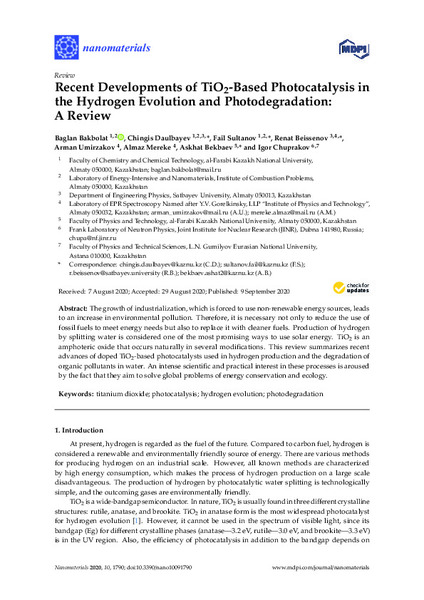
| dc.description.abstract | The growth of industrialization, which is forced to use non-renewable energy sources, leads to an increase in environmental pollution. Therefore, it is necessary not only to reduce the use of fossil fuels to meet energy needs but also to replace it with cleaner fuels. Production of hydrogen by splitting water is considered one of the most promising ways to use solar energy. TiO2 is an amphoteric oxide that occurs naturally in several modifications. This review summarizes recent advances of doped TiO2-based photocatalysts used in hydrogen production and the degradation of organic pollutants in water. An intense scientific and practical interest in these processes is aroused by the fact that they aim to solve global problems of energy conservation and ecology. | ru |
| dc.language.iso | en | ru |
| dc.publisher | Nanomaterials | ru |
| dc.relation.ispartofseries | 10, 1790; | |
| dc.subject | titanium dioxide | ru |
| dc.subject | photocatalysis | ru |
| dc.subject | hydrogen evolution | ru |
| dc.subject | photodegradation | ru |
| dc.title | Recent Developments of TiO2-Based Photocatalysis in the Hydrogen Evolution and Photodegradation: A Review | ru |
| dc.type | Article | ru |
Файлы в этом документе
Данный элемент включен в следующие коллекции
-
Materials Science[559]