Показать сокращенную информацию
Theoretical aspects of intellectual migration research
| dc.contributor.author | Kaliaskarova, G.B. | |
| dc.date.accessioned | 2023-08-08T10:42:42Z | |
| dc.date.available | 2023-08-08T10:42:42Z | |
| dc.date.issued | 2022 | |
| dc.identifier.issn | 2616-6887 | |
| dc.identifier.uri | http://rep.enu.kz/handle/enu/4478 | |
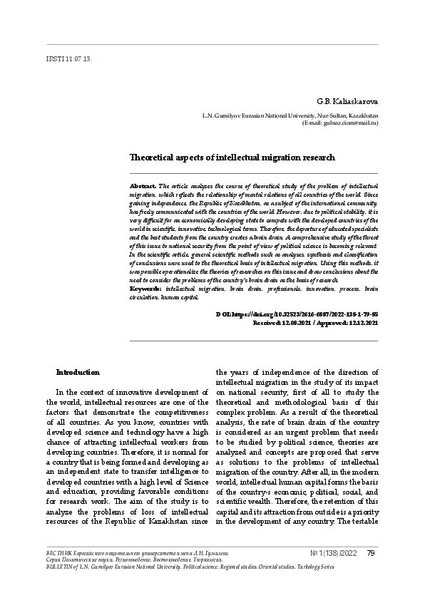
| dc.description.abstract | The article analyzes the course of theoretical study of the problem of intellectual migration, which reflects the relationship of mental relations of all countries of the world. Since gaining independence, the Republic of Kazakhstan, as a subject of the international community, has freely communicated with the countries of the world. However, due to political stability, it is very difficult for an economically developing state to compete with the developed countries of the world in scientific, innovative, technological terms. Therefore, the departure of educated specialists and the best students from the country creates a brain drain. A comprehensive study of the threat of this issue to national security from the point of view of political science is becoming relevant. In the scientific article, general scientific methods such as analyses, synthesis and classification of conclusions were used to the theoretical basis of intellectual migration. Using this methods, it was possible operationalize the theories of researches on this issue and draw conclusions about the need to consider the problems of the country’s brain drain as the basis of research. | ru |
| dc.language.iso | en | ru |
| dc.publisher | L.N.Gumilyov Eurasian National University | ru |
| dc.subject | intellectual migration | ru |
| dc.subject | brain drain | ru |
| dc.subject | professionals | ru |
| dc.subject | innovation | ru |
| dc.subject | process | ru |
| dc.subject | brain circulation | ru |
| dc.subject | human capital | ru |
| dc.title | Theoretical aspects of intellectual migration research | ru |
| dc.type | Article | ru |