Показать сокращенную информацию
Nomads yurt as an archetype
| dc.contributor.author | Demessinova, L.M. | |
| dc.contributor.author | Sayfulina, F.S. | |
| dc.contributor.author | Kinaci, C. | |
| dc.date.accessioned | 2023-08-17T09:48:49Z | |
| dc.date.available | 2023-08-17T09:48:49Z | |
| dc.date.issued | 2021 | |
| dc.identifier.issn | 2616-678Х | |
| dc.identifier.uri | http://rep.enu.kz/handle/enu/5086 | |
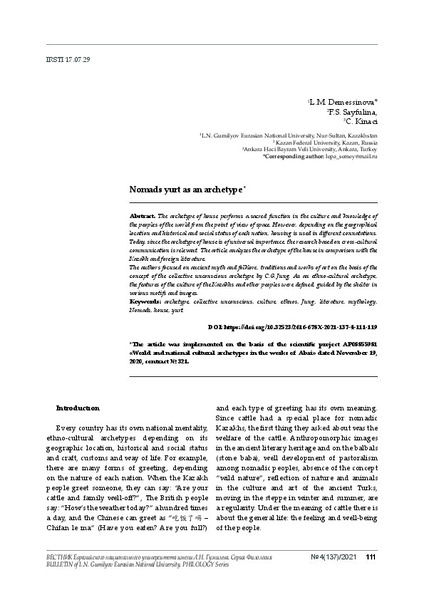
| dc.description.abstract | The archetype of house performs a sacred function in the culture and knowledge of the peoples of the world from the point of view of space. However, depending on the geographical location and historical and social status of each nation, housing is used in different connatations. Today, since the archetype of house is of universal importance, the research based on cross-cultural communication is relevant. The article analyzes the archetype of the house in comparison with the Kazakh and foreign literature. The authors focused on ancient myth and folklore, traditions and works of art on the basis of the concept of the collective unconscious archetype by C.G.Jung. As an ethno-cultural archetype, the features of the culture of the Kazakhs and other peoples were defined, guided by the shelter in various motifs and images. | ru |
| dc.language.iso | en | ru |
| dc.publisher | L.N.Gumilyov Eurasian National University | ru |
| dc.subject | archetype | ru |
| dc.subject | collective unconscious | ru |
| dc.subject | culture | ru |
| dc.subject | ethnos | ru |
| dc.subject | Jung | ru |
| dc.subject | literature | ru |
| dc.subject | mythology | ru |
| dc.subject | Nomads | ru |
| dc.subject | house | ru |
| dc.subject | yurt | ru |
| dc.title | Nomads yurt as an archetype | ru |
| dc.type | Article | ru |