Показать сокращенную информацию
Methods of coating a three-dimensional structure with polymer electrolytes for lithium-ion batteries
| dc.contributor.author | Beysembaeva, K.A. | |
| dc.contributor.author | Nurymov, Zh.D. | |
| dc.date.accessioned | 2023-08-21T06:30:00Z | |
| dc.date.available | 2023-08-21T06:30:00Z | |
| dc.date.issued | 2021 | |
| dc.identifier.issn | 2616-6771 | |
| dc.identifier.uri | http://rep.enu.kz/handle/enu/5227 | |
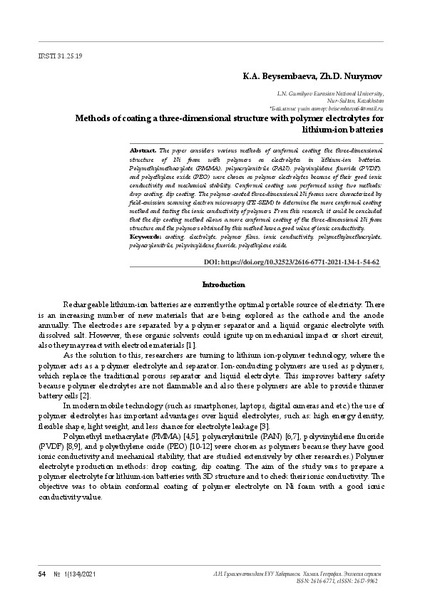
| dc.description.abstract | The paper considers various methods of conformal coating the three-dimensional structure of Ni foam with polymers as electrolytes in lithium-ion batteries. Polymethylmethacrylate (PMMA), polyacrylonitrile (PAN), polyvinylidene fluoride (PVDF), and polyethylene oxide (PEO) were chosen as polymer electrolytes because of their good ionic conductivity and mechanical stability. Conformal coating was performed using two methods: drop coating, dip coating. The polymer-coated three-dimensional Ni foams were characterized by field-emission scanning electron microscopy (FE-SEM) to determine the more conformal coating method and testing the ionic conductivity of polymers. From this research, it could be concluded that the dip coating method allows a more conformal coating of the three-dimensional Ni foam structure and the polymers obtained by this method have a good value of ionic conductivity. | ru |
| dc.language.iso | en | ru |
| dc.publisher | L.N.Gumilyov Eurasian National University | ru |
| dc.subject | coating | ru |
| dc.subject | electrolyte | ru |
| dc.subject | polymer films | ru |
| dc.subject | ionic conductivity | ru |
| dc.subject | polymethylmethacrylate | ru |
| dc.subject | polyacrylonitrile | ru |
| dc.subject | polyvinylidene fluoride | ru |
| dc.subject | polyethylene oxide | ru |
| dc.title | Methods of coating a three-dimensional structure with polymer electrolytes for lithium-ion batteries | ru |
| dc.type | Article | ru |