Показать сокращенную информацию
Decreasing of the concentration quenching of fluorescent dye in a solution by introducing it to nanoparticles of silicon dioxide
| dc.contributor.author | Mantel, A.I. | |
| dc.contributor.author | Yensebayeva, A.E. | |
| dc.contributor.author | Smatov, S.B. | |
| dc.contributor.author | Irgibayeva, I.S. | |
| dc.date.accessioned | 2023-12-04T08:18:49Z | |
| dc.date.available | 2023-12-04T08:18:49Z | |
| dc.date.issued | 2018 | |
| dc.identifier.other | DOI: 10.29317/ejpfm.2018020203 | |
| dc.identifier.uri | http://rep.enu.kz/handle/enu/10652 | |
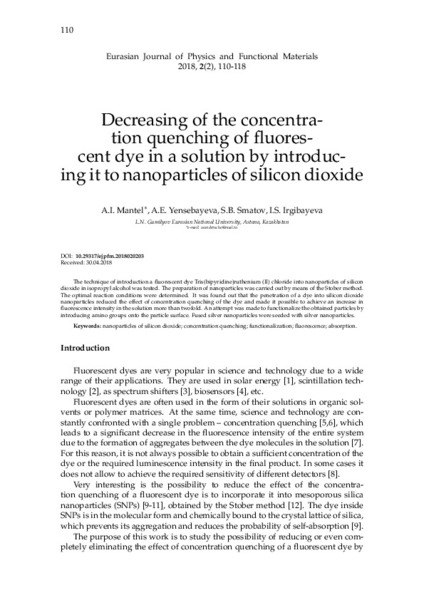
| dc.description.abstract | The technique of introduction a fluorescent dye Tris(bipyridine)ruthenium (II) chloride into nanoparticles of silicon dioxide in isopropyl alcohol was tested. The preparation of nanoparticles was carried out by means of the Stober method. The optimal reaction conditions were determined. It was found out that the penetration of a dye into silicon dioxide nanoparticles reduced the effect of concentration quenching of the dye and made it possible to achieve an increase in fluorescence intensity in the solution more than twofold. An attempt was made to functionalize the obtained particles by introducing amino groups onto the particle surface. Fused silver nanoparticles were seeded with silver nanoparticles. | ru |
| dc.language.iso | en | ru |
| dc.relation.ispartofseries | Vol. 2(2);110-118 | |
| dc.subject | nanoparticles of silicon dioxide | ru |
| dc.subject | concentration quenching | ru |
| dc.subject | functionalization | ru |
| dc.subject | fluorescence | ru |
| dc.subject | absorption | ru |
| dc.title | Decreasing of the concentration quenching of fluorescent dye in a solution by introducing it to nanoparticles of silicon dioxide | ru |
| dc.type | Article | ru |