
Показать сокращенную информацию
Digital Platform Employment in Kazakhstan: Can New Technologies Solve Old Problems in the Labor Market?
| dc.contributor.author | Insebayeva, Sabina | |
| dc.contributor.author | Beyssembayev, Serik | |
| dc.date.accessioned | 2024-09-16T11:31:25Z | |
| dc.date.available | 2024-09-16T11:31:25Z | |
| dc.date.issued | 2023 | |
| dc.identifier.citation | Insebayeva S, Beyssembayev S (2023). Digital Platform Employment in Kazakhstan: Can New Technologies Solve Old Problems in the Labor Market? International Labor and Working-Class History 103, 62–80. https://doi.org/10.1017/S0147547923000200 | ru |
| dc.identifier.uri | https://doi.org/10.1017/S0147547923000200 | |
| dc.identifier.uri | http://rep.enu.kz/handle/enu/16412 | |
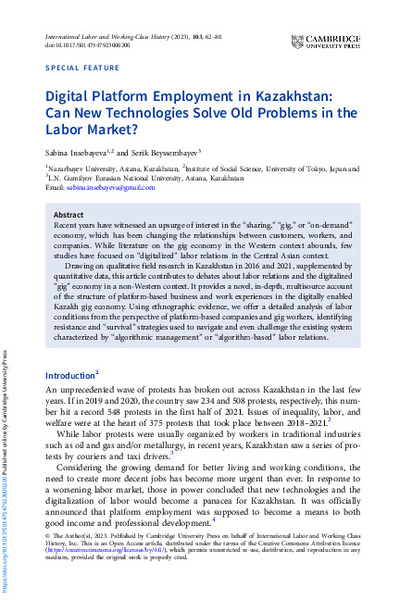
| dc.description.abstract | Recent years have witnessed an upsurge of interest in the “sharing,” “gig,” or “on-demand” economy, which has been changing the relationships between customers, workers, and companies. While literature on the gig economy in the Western context abounds, few studies have focused on “digitalized” labor relations in the Central Asian context. Drawing on qualitative field research in Kazakhstan in 2016 and 2021, supplemented by quantitative data, this article contributes to debates about labor relations and the digitalized “gig” economy in a non-Western context. It provides a novel, in-depth, multisource account of the structure of platform-based business and work experiences in the digitally enabled Kazakh gig economy. Using ethnographic evidence, we offer a detailed analysis of labor conditions from the perspective of platform-based companies and gig workers, identifying resistance and “survival” strategies used to navigate and even challenge the existing system characterized by “algorithmic management” or “algorithm-based” labor relations. | ru |
| dc.language.iso | en | ru |
| dc.publisher | International Labor and Working-Class History | ru |
| dc.relation.ispartofseries | 103;Pages 62–80 | |
| dc.title | Digital Platform Employment in Kazakhstan: Can New Technologies Solve Old Problems in the Labor Market? | ru |
| dc.type | Article | ru |
Файлы в этом документе
Данный элемент включен в следующие коллекции
-
Arts and Humanities[252]