
Показать сокращенную информацию
The Idea of Eternal Country in the First Epic Poems of the Turkic People
| dc.contributor.author | Alimbayev, Aslan E. | |
| dc.contributor.author | Daurenbekova, Laura N. | |
| dc.contributor.author | Kemenger, Kayrbek R. | |
| dc.contributor.author | Imanberdiyeva, Saule K. | |
| dc.contributor.author | Bashirov, Nurbol K. | |
| dc.date.accessioned | 2024-09-18T07:08:47Z | |
| dc.date.available | 2024-09-18T07:08:47Z | |
| dc.date.issued | 2020-07 | |
| dc.identifier.issn | 0975-2935 | |
| dc.identifier.uri | https://dx.doi.org/10.21659/rupkatha.v12n4.29 | |
| dc.identifier.uri | http://rep.enu.kz/handle/enu/16594 | |
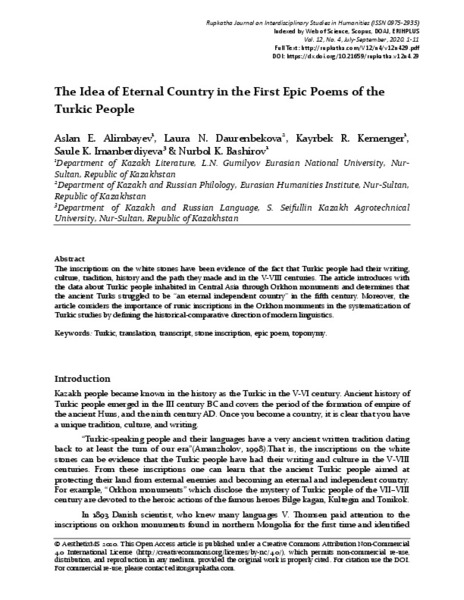
| dc.description.abstract | The inscriptions on the white stones have been evidence of the fact that Turkic people had their writing, culture, tradition, history and the path they made and in the V-VIII centuries. The article introduces with the data about Turkic people inhabited in Central Asia through Orkhon monuments and determines that the ancient Turks struggled to be “an eternal independent country” in the fifth century. Moreover, the article considers the importance of runic inscriptions in the Orkhon monuments in the systematization of Turkic studies by defining the historical-comparative direction of modern linguistics. | ru |
| dc.language.iso | en | ru |
| dc.publisher | Rupkatha Journal on Interdisciplinary Studies in Humanities | ru |
| dc.relation.ispartofseries | Volume 12, Issue 4;Pages 1 - 11 | |
| dc.subject | Epic poem | ru |
| dc.subject | Stone inscription | ru |
| dc.subject | Toponymy | ru |
| dc.subject | Transcript | ru |
| dc.subject | Translation | ru |
| dc.subject | Turkic | ru |
| dc.title | The Idea of Eternal Country in the First Epic Poems of the Turkic People | ru |
| dc.type | Article | ru |
Файлы в этом документе
Данный элемент включен в следующие коллекции
-
Arts and Humanities[252]