
Показать сокращенную информацию
New high-pressure phases of Fe7N3 and Fe7C3 stable at Earth's core conditions: evidences for carbon–nitrogen isomorphism in Fe-compounds
| dc.contributor.author | Sagatov, Nursultan | |
| dc.contributor.author | Gavryushkin, Pavel N. | |
| dc.contributor.author | Inerbaev, Talgat M. | |
| dc.contributor.author | Litasov, Konstantin D. | |
| dc.date.accessioned | 2024-09-18T07:59:44Z | |
| dc.date.available | 2024-09-18T07:59:44Z | |
| dc.date.issued | 2019 | |
| dc.identifier.issn | 2046-2069 | |
| dc.identifier.other | DOI: 10.1039/c8ra09942a | |
| dc.identifier.uri | http://rep.enu.kz/handle/enu/16611 | |
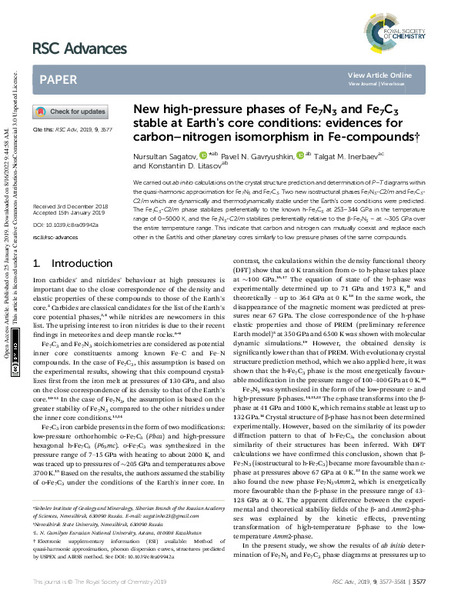
| dc.description.abstract | We carried out ab initio calculations on the crystal structure prediction and determination of P–T diagrams within the quasi-harmonic approximation for Fe7N3 and Fe7C3. Two new isostructural phases Fe7N3-C2/m and Fe7C3- C2/m which are dynamically and thermodynamically stable under the Earth's core conditions were predicted. The Fe7C3-C2/m phase stabilizes preferentially to the known h-Fe7C3 at 253–344 GPa in the temperature range of 0–5000 K, and the Fe7N3-C2/m stabilizes preferentially relative to the b-Fe7N3 – at 305 GPa over the entire temperature range. This indicate that carbon and nitrogen can mutually coexist and replace each other in the Earth's and other planetary cores similarly to low pressure phases of the same compounds. | ru |
| dc.language.iso | en | ru |
| dc.publisher | RSC Advances | ru |
| dc.relation.ispartofseries | 9;3577 | |
| dc.title | New high-pressure phases of Fe7N3 and Fe7C3 stable at Earth's core conditions: evidences for carbon–nitrogen isomorphism in Fe-compounds | ru |
| dc.type | Article | ru |
Файлы в этом документе
Данный элемент включен в следующие коллекции
-
Chemistry[249]