Показать сокращенную информацию
Applying machine learning to improve a texture type image
| dc.contributor.author | Tussupov, Jamalbek | |
| dc.contributor.author | Kozhabai, Kairat | |
| dc.contributor.author | Bayegizova, Aigulim | |
| dc.contributor.author | Kassenova, Leila | |
| dc.date.accessioned | 2024-09-19T09:23:18Z | |
| dc.date.available | 2024-09-19T09:23:18Z | |
| dc.date.issued | 2023 | |
| dc.identifier.citation | Tussupov, J., Kozhabai, K., Bayegizova, A., Kassenova, L., Manbetova, Z., Glazyrina, N., Bersugir, M., Yeginbayev, M. (2023). Applying machine learning to improve a texture type image. Eastern-European Journal of Enterprise Technologies, 2 (2 (122)), 13–18 doi: https://doi.org/10.15587/1729-4061.2023.275984 | ru |
| dc.identifier.issn | 1729-3774 | |
| dc.identifier.uri | https://doi.org/10.15587/1729-4061.2023.275984 | |
| dc.identifier.uri | http://rep.enu.kz/handle/enu/16658 | |
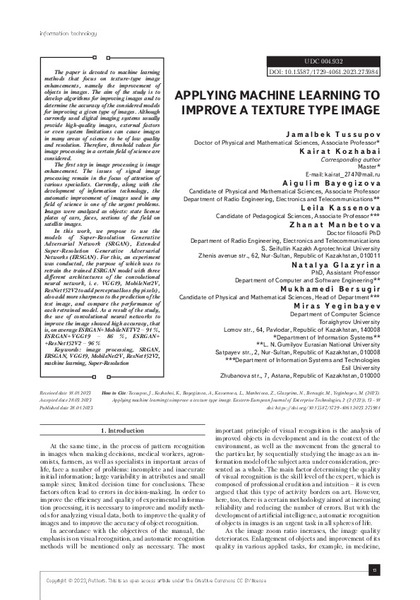
| dc.description.abstract | The paper is devoted to machine learning methods that focus on texture-type image enhancements, namely the improvement of objects in images. The aim of the study is to develop algorithms for improving images and to determine the accuracy of the considered models for improving a given type of images. Although currently used digital imaging systems usually provide high-quality images, external factors or even system limitations can cause images in many areas of science to be of low quality and resolution. Therefore, threshold values for image processing in a certain field of science are considered. The first step in image processing is image enhancement. The issues of signal image processing remain in the focus of attention of various specialists. Currently, along with the development of information technology, the automatic improvement of images used in any field of science is one of the urgent problems. Images were analyzed as objects: state license plates of cars, faces, sections of the field on satellite images. In this work, we propose to use the models of Super-Resolution Generative Adversarial Network (SRGAN), Extended Super-Resolution Generative Adversarial Networks (ERSGAN). For this, an experiment was conducted, the purpose of which was to retrain the trained ESRGAN model with three different architectures of the convolutional neural network, i. e. VGG19, MobileNet2V, ResNet152V2 to add perceptual loss (by pixels), also add more sharpness to the prediction of the test image, and compare the performance of each retrained model. As a result of the study, the use of convolutional neural networks to improve the image showed high accuracy, that is, on average ESRGAN+MobileNETV2 – 91 %, ESRGAN+VGG19 – 86 %, ESRGAN+ +ResNet152V2 – 96 %. | ru |
| dc.language.iso | en | ru |
| dc.publisher | Eastern-European Journal of Enterprise Technologies | ru |
| dc.relation.ispartofseries | Volume 2, Issue 2-122;Pages 13 - 18 | |
| dc.subject | ERSGAN | ru |
| dc.subject | image processing | ru |
| dc.subject | machine learning | ru |
| dc.subject | MobileNet2V | ru |
| dc.subject | ResNet152V2 | ru |
| dc.subject | SRGAN | ru |
| dc.subject | Super-Resolution | ru |
| dc.subject | VGG19 | ru |
| dc.title | Applying machine learning to improve a texture type image | ru |
| dc.type | Article | ru |