
Показать сокращенную информацию
Functionalization of PET Track-Etched Membranes by UV-Induced Graft (co)Polymerization for Detection of Heavy Metal Ions in Water
| dc.contributor.author | Zdorovets, Maxim V. | |
| dc.contributor.author | Korolkov, Ilya V. | |
| dc.contributor.author | Yeszhanov, Arman B. | |
| dc.contributor.author | Gorin, Yevgeniy G. | |
| dc.date.accessioned | 2024-09-20T04:40:12Z | |
| dc.date.available | 2024-09-20T04:40:12Z | |
| dc.date.issued | 2019 | |
| dc.identifier.issn | 2073-4360 | |
| dc.identifier.other | doi:10.3390/polym11111876 | |
| dc.identifier.uri | http://rep.enu.kz/handle/enu/16710 | |
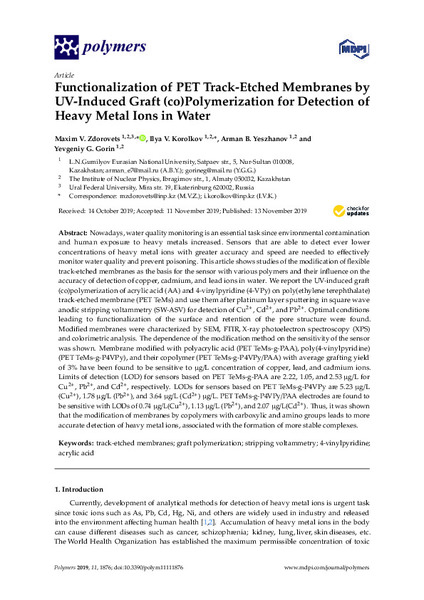
| dc.description.abstract | Nowadays, water quality monitoring is an essential task since environmental contamination and human exposure to heavy metals increased. Sensors that are able to detect ever lower concentrations of heavy metal ions with greater accuracy and speed are needed to effectively monitor water quality and prevent poisoning. This article shows studies of the modification of flexible track-etched membranes as the basis for the sensor with various polymers and their influence on the accuracy of detection of copper, cadmium, and lead ions in water. We report the UV-induced graft (co)polymerization of acrylic acid (AA) and 4-vinylpyridine (4-VPy) on poly(ethylene terephthalate) track-etched membrane (PET TeMs) and use them after platinum layer sputtering in square wave anodic stripping voltammetry (SW-ASV) for detection of Cu2+, Cd2+, and Pb2+. Optimal conditions leading to functionalization of the surface and retention of the pore structure were found. Modified membranes were characterized by SEM, FTIR, X-ray photoelectron spectroscopy (XPS) and colorimetric analysis. The dependence of the modification method on the sensitivity of the sensor was shown. Membrane modified with polyacrylic acid (PET TeMs-g-PAA), poly(4-vinylpyridine) (PET TeMs-g-P4VPy), and their copolymer (PET TeMs-g-P4VPy/PAA) with average grafting yield of 3% have been found to be sensitive to µg/L concentration of copper, lead, and cadmium ions. Limits of detection (LOD) for sensors based on PET TeMs-g-PAA are 2.22, 1.05, and 2.53 µg/L for Cu2+, Pb2+, and Cd2+, respectively. LODs for sensors based on PET TeMs-g-P4VPy are 5.23 µg/L (Cu2+), 1.78 µg/L (Pb2+), and 3.64 µg/L (Cd2+) µg/L. PET TeMs-g-P4VPy/PAA electrodes are found to be sensitive with LODs of 0.74 µg/L(Cu2+), 1.13 µg/L (Pb2+), and 2.07 µg/L(Cd2+). Thus, it was shown that the modification of membranes by copolymers with carboxylic and amino groups leads to more accurate detection of heavy metal ions, associated with the formation of more stable complexes. | ru |
| dc.language.iso | en | ru |
| dc.publisher | Polymers | ru |
| dc.relation.ispartofseries | Volume 11 Issue 11; | |
| dc.subject | track-etched membranes | ru |
| dc.subject | graft polymerization | ru |
| dc.subject | stripping voltammetry | ru |
| dc.subject | 4-vinylpyridine | ru |
| dc.subject | acrylic acid | ru |
| dc.title | Functionalization of PET Track-Etched Membranes by UV-Induced Graft (co)Polymerization for Detection of Heavy Metal Ions in Water | ru |
| dc.type | Article | ru |
Файлы в этом документе
Данный элемент включен в следующие коллекции
-
Chemistry[249]