
Показать сокращенную информацию
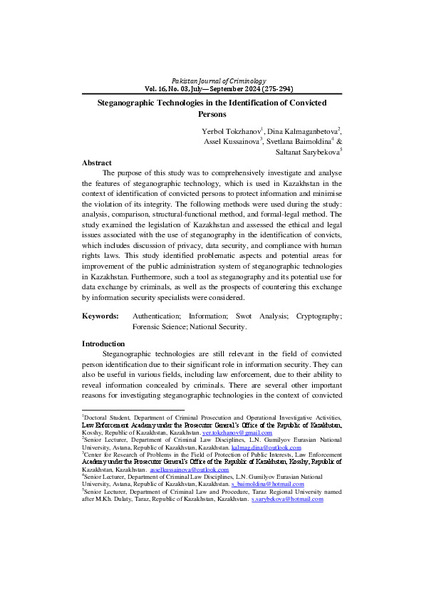
Steganographic Technologies in the Identification of Convicted Persons
| dc.contributor.author | Tokzhanov, Yerbol | |
| dc.contributor.author | Kalmaganbetova, Dina | |
| dc.contributor.author | Kussainova, Assel | |
| dc.contributor.author | Baimoldina, Svetlana | |
| dc.contributor.author | Sarybekova, Saltanat | |
| dc.date.accessioned | 2024-10-21T05:32:02Z | |
| dc.date.available | 2024-10-21T05:32:02Z | |
| dc.date.issued | 2024-09 | |
| dc.identifier.issn | 20742738 | |
| dc.identifier.other | DOI 10.62271/pjc.16.3.275.294 | |
| dc.identifier.uri | http://rep.enu.kz/handle/enu/18019 | |
| dc.description.abstract | The purpose of this study was to comprehensively investigate and analyse the features of steganographic technology, which is used in Kazakhstan in the context of identification of convicted persons to protect information and minimise the violation of its integrity. The following methods were used during the study: analysis, comparison, structural-functional method, and formal-legal method. The study examined the legislation of Kazakhstan and assessed the ethical and legal issues associated with the use of steganography in the identification of convicts, which includes discussion of privacy, data security, and compliance with human rights laws. This study identified problematic aspects and potential areas for improvement of the public administration system of steganographic technologies in Kazakhstan. Furthermore, such a tool as steganography and its potential use for data exchange by criminals, as well as the prospects of countering this exchange by information security specialists were considered. | ru |
| dc.language.iso | en | ru |
| dc.publisher | Pakistan Journal of Criminology | ru |
| dc.relation.ispartofseries | Vol. 16, No. 03; | |
| dc.subject | Authentication | ru |
| dc.subject | Information | ru |
| dc.subject | Swot Analysis | ru |
| dc.subject | Cryptography | ru |
| dc.subject | Forensic Science | ru |
| dc.subject | National Security | ru |
| dc.title | Steganographic Technologies in the Identification of Convicted Persons | ru |
| dc.type | Article | ru |
Файлы в этом документе
Данный элемент включен в следующие коллекции
-
Social Sciences[759]