
Показать сокращенную информацию
Development of research capacity of a future social pedagogue in the face of digital technologies
| dc.contributor.author | Maussumbayev, Rysbek | |
| dc.contributor.author | Toleubekova, Rymshash | |
| dc.contributor.author | Kaziyev, Karas | |
| dc.contributor.author | Baibaktina, Axaule | |
| dc.contributor.author | Bekbauova, Altynshash | |
| dc.date.accessioned | 2024-10-22T08:00:34Z | |
| dc.date.available | 2024-10-22T08:00:34Z | |
| dc.date.issued | 2022 | |
| dc.identifier.issn | 1360-2357 | |
| dc.identifier.other | doi.org/10.1007/s10639-022-10901-3 | |
| dc.identifier.uri | http://rep.enu.kz/handle/enu/18201 | |
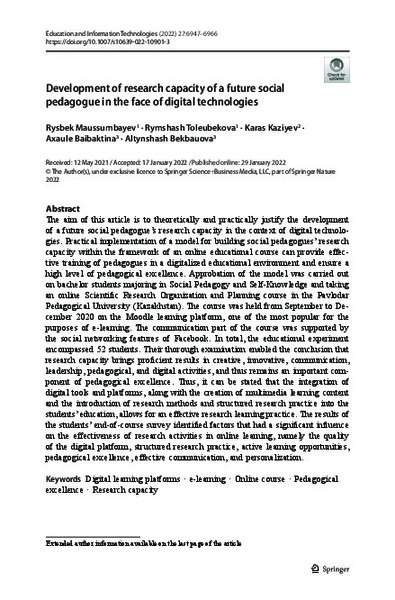
| dc.description.abstract | The aim of this article is to theoretically and practically justify the development of a future social pedagogue’s research capacity in the context of digital technologies. Practical implementation of a model for building social pedagogues’ research capacity within the framework of an online educational course can provide efective training of pedagogues in a digitalized educational environment and ensure a high level of pedagogical excellence. Approbation of the model was carried out on bachelor students majoring in Social Pedagogy and Self-Knowledge and taking an online Scientifc Research Organization and Planning course in the Pavlodar Pedagogical University (Kazakhstan). The course was held from September to December 2020 on the Moodle learning platform, one of the most popular for the purposes of e-learning. The communication part of the course was supported by the social networking features of Facebook. In total, the educational experiment encompassed 52 students. Their thorough examination enabled the conclusion that research capacity brings profcient results in creative, innovative, communication, leadership, pedagogical, and digital activities, and thus remains an important component of pedagogical excellence. Thus, it can be stated that the integration of digital tools and platforms, along with the creation of multimedia learning content and the introduction of research methods and structured research practice into the students’ education, allows for an efective research learning practice. The results of the students’ end-of-course survey identifed factors that had a signifcant infuence on the efectiveness of research activities in online learning, namely the quality of the digital platform, structured research practice, active learning opportunities, pedagogical excellence, efective communication, and personalization. | ru |
| dc.language.iso | en | ru |
| dc.publisher | Education and Information Technologies | ru |
| dc.relation.ispartofseries | 27:6947–6966; | |
| dc.subject | Digital learning platforms | ru |
| dc.subject | e-learning | ru |
| dc.subject | Online course | ru |
| dc.subject | Pedagogical excellence | ru |
| dc.subject | Research capacity | ru |
| dc.title | Development of research capacity of a future social pedagogue in the face of digital technologies | ru |
| dc.type | Article | ru |
Файлы в этом документе
Данный элемент включен в следующие коллекции
-
Social Sciences[759]