
Показать сокращенную информацию
Prioritization of Pharmaceuticals Based on Risks to Aquatic Environments in Kazakhstan
| dc.contributor.author | Aubakirova, Bakhyt | |
| dc.contributor.author | Beisenova, Raikhan | |
| dc.contributor.author | BA Boxall, Alistair | |
| dc.date.accessioned | 2024-10-28T05:34:01Z | |
| dc.date.available | 2024-10-28T05:34:01Z | |
| dc.date.issued | 2016 | |
| dc.identifier.issn | 1551-3793 | |
| dc.identifier.other | DOI: 10.1002/ieam.1895 | |
| dc.identifier.uri | http://rep.enu.kz/handle/enu/18360 | |
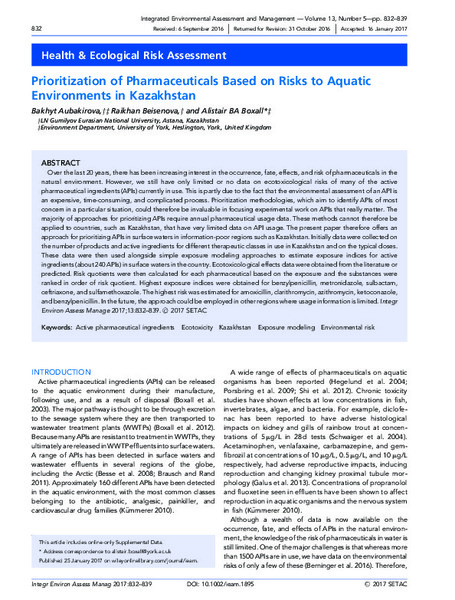
| dc.description.abstract | Over the last 20 years, there has been increasing interest in the occurrence, fate, effects, and risk of pharmaceuticals in the natural environment. However, we still have only limited or no data on ecotoxicological risks of many of the active pharmaceutical ingredients (APIs) currently in use. This is partly due to the fact that the environmental assessment of an API is an expensive, time-consuming, and complicated process. Prioritization methodologies, which aim to identify APIs of most concern in a particular situation, could therefore be invaluable in focusing experimental work on APIs that really matter. The majority of approaches for prioritizing APIs require annual pharmaceutical usage data. These methods cannot therefore be applied to countries, such as Kazakhstan, that have very limited data on API usage. The present paper therefore offers an approach for prioritizing APIs in surface waters in information-poor regions such as Kazakhstan. Initially data were collected on the number of products and active ingredients for different therapeutic classes in use in Kazakhstan and on the typical doses. These data were then used alongside simple exposure modeling approaches to estimate exposure indices for active ingredients (about 240 APIs) in surface waters in the country. Ecotoxicological effects data were obtained from the literature or predicted. Risk quotients were then calculated for each pharmaceutical based on the exposure and the substances were ranked in order of risk quotient. Highest exposure indices were obtained for benzylpenicillin, metronidazole, sulbactam, ceftriaxone, and sulfamethoxazole. The highest risk was estimated for amoxicillin, clarithromycin, azithromycin, ketoconazole, and benzylpenicillin. In the future, the approach could be employed in other regions where usage information is limited. Integr Environ Assess Manage 2017;13:832–839. C 2017 SETAC | ru |
| dc.language.iso | en | ru |
| dc.publisher | Integrated Environmental Assessment and Management | ru |
| dc.relation.ispartofseries | Volume 13, Number 5—pp. 832–839; | |
| dc.subject | Active pharmaceutical ingredients | ru |
| dc.subject | Ecotoxicity | ru |
| dc.subject | Kazakhstan | ru |
| dc.subject | Exposure modeling | ru |
| dc.subject | Environmental risk | ru |
| dc.title | Prioritization of Pharmaceuticals Based on Risks to Aquatic Environments in Kazakhstan | ru |
| dc.type | Article | ru |
Файлы в этом документе
Данный элемент включен в следующие коллекции
-
Social Sciences[759]