
Показать сокращенную информацию
INTERTEXTUALITY AND ARCHETYPE TRANSFORMATION AS THE POLYSEMY BASIS OF THE MODERN REIMAGINED FAIRY TALE
| dc.contributor.author | Nurgali, Kadisha R. | |
| dc.contributor.author | Gilea, Aigerim A. | |
| dc.date.accessioned | 2024-10-28T06:14:09Z | |
| dc.date.available | 2024-10-28T06:14:09Z | |
| dc.date.issued | 2023 | |
| dc.identifier.citation | Nurgali, K.R., Gilea, A.A. “Intertextuality and Archetype Transformation as the Polysemy Basis of the Modern Reimagined Fairy Tale.” Studia Litterarum, vol. 8, no. 1, 2023, pp. 198–217. (In English) https://doi.org/10.22455/2500-4247-2023-8-1-198-217 | ru |
| dc.identifier.issn | 2500-4247 | |
| dc.identifier.other | doi.org/10.22455/2500-4247-2023-8-1-198-217 | |
| dc.identifier.uri | http://rep.enu.kz/handle/enu/18368 | |
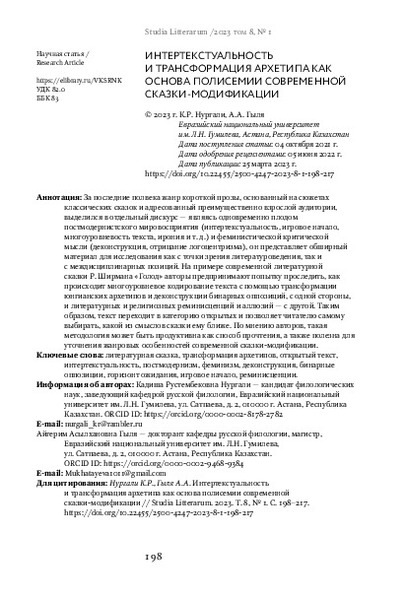
| dc.description.abstract | In the modern English-language literary space the genre of short prose, based on the plots of classical fairy tales and addressed primarily to an adult audience, is extremely popular. Over half a century already, this genre has emerged as a separate discourse (in this article, the authors call it a “Reimagined Fairy Tale,” considering the memory of the genre). Such modificated fairy tale is simultaniously the result of the postmodern world perception (intertextuality, playfulness, gamification, multilevel text, irony, etc.) and a critical thought (deconstruction, denial of logocentrism), and represents an extensive material for research both from the point of view of literary criticism and from interdisciplinary positions. Using the example of the modern literary tale by R. Shirman “Hunger,” which is based on the folk story about Hansel and Gretel, the authors attempt to trace how the multilevel coding of the text takes place using the transformation of Jungian archetypes and deconstruction of binary oppositions that underlie them on the one hand, and literary and religious reminiscences, and allusions on the other. The authors trace how the text passes into the category of open ones and allows the reader to choose himself which of the meanings of the tale is closer to him. According to the authors, this methodology is applicable to all texts of a given genre and can be productive as a way of reading, and also useful for clarifying the genre features of a modern fairy tale-modification. | ru |
| dc.language.iso | en | ru |
| dc.publisher | Studia Litterarum | ru |
| dc.relation.ispartofseries | vol. 8, no. 1; | |
| dc.subject | literary tale | ru |
| dc.subject | archetypes’ transformation | ru |
| dc.subject | opened text | ru |
| dc.subject | intertextuality | ru |
| dc.subject | postmodernism | ru |
| dc.subject | feminism | ru |
| dc.subject | deconstruction | ru |
| dc.subject | binary oppositions | ru |
| dc.subject | waiting horizon | ru |
| dc.subject | gamified beginning | ru |
| dc.subject | reminiscences | ru |
| dc.title | INTERTEXTUALITY AND ARCHETYPE TRANSFORMATION AS THE POLYSEMY BASIS OF THE MODERN REIMAGINED FAIRY TALE | ru |
| dc.title.alternative | ИНТЕРТЕКСТУАЛЬНОСТЬ И ТРАНСФОРМАЦИЯ АРХЕТИПА КАК ОСНОВА ПОЛИСЕМИИ СОВРЕМЕННОЙ СКАЗКИ-МОДИФИКАЦИИ | ru |
| dc.type | Article | ru |
Файлы в этом документе
Данный элемент включен в следующие коллекции
-
Social Sciences[759]