
Показать сокращенную информацию
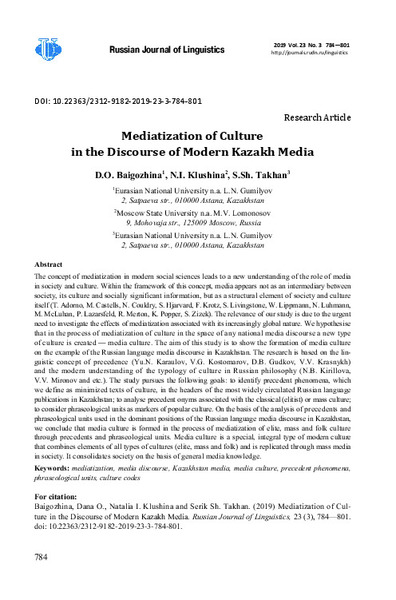
Mediatization of Culture in the Discourse of Modern Kazakh Media
| dc.contributor.author | Baigozhina, D.O. | |
| dc.contributor.author | Klushina, N.I. | |
| dc.contributor.author | Takhanzhina, S.Sh. | |
| dc.contributor.author | Klushina, N.I. | |
| dc.contributor.author | Takhan, S.Sh. | |
| dc.date.accessioned | 2024-11-01T04:59:41Z | |
| dc.date.available | 2024-11-01T04:59:41Z | |
| dc.date.issued | 2019 | |
| dc.identifier.issn | 2686-8024 | |
| dc.identifier.other | DOI: 10.22363/2312-9182-2019-23-3-784-801 | |
| dc.identifier.uri | http://rep.enu.kz/handle/enu/18394 | |
| dc.description.abstract | The concept of mediatization in modern social sciences leads to a new understanding of the role of media in society and culture. Within the framework of this concept, media appears not as an intermediary between society, its culture and socially significant information, but as a structural element of society and culture itself (T. Adorno, M. Castells, N. Couldry, S. Hjarvard, F. Krotz, S. Livingstone, W. Lippmann, N. Luhmann, M. McLuhan, P. Lazarsfeld, R. Merton, K. Popper, S. Zizek). The relevance of our study is due to the urgent need to investigate the effects of mediatization associated with its increasingly global nature. We hypothesise that in the process of mediatization of culture in the space of any national media discourse a new type of culture is created — media culture. The aim of this study is to show the formation of media culture on the example of the Russian language media discourse in Kazakhstan. The research is based on the linguistic concept of precedence (Yu.N. Karaulov, V.G. Kostomarov, D.B. Gudkov, V.V. Krasnykh) and the modern understanding of the typology of culture in Russian philosophy (N.B. Kirillova, V.V. Mironov and etc.). The study pursues the following goals: to identify precedent phenomena, which we define as minimized texts of culture, in the headers of the most widely circulated Russian language publications in Kazakhstan; to analyse precedent onyms associated with the classical (elitist) or mass culture; to consider phraseological units as markers of popular culture. On the basis of the analysis of precedents and phraseological units used in the dominant positions of the Russian language media discourse in Kazakhstan, we conclude that media culture is formed in the process of mediatization of elite, mass and folk culture through precedents and phraseological units. Media culture is a special, integral type of modern culture that combines elements of all types of cultures (elite, mass and folk) and is replicated through mass media in society. It consolidates society on the basis of general media knowledge. | ru |
| dc.language.iso | en | ru |
| dc.publisher | Russian Journal of Linguistics | ru |
| dc.relation.ispartofseries | Vol. 23 No. 3 784—801; | |
| dc.subject | mediatization | ru |
| dc.subject | media discourse | ru |
| dc.subject | Kazakhstan media | ru |
| dc.subject | media culture | ru |
| dc.subject | precedent phenomena | ru |
| dc.subject | phraseological units | ru |
| dc.subject | culture codes | ru |
| dc.title | Mediatization of Culture in the Discourse of Modern Kazakh Media | ru |
| dc.type | Article | ru |
Файлы в этом документе
Данный элемент включен в следующие коллекции
-
Social Sciences[759]