
Показать сокращенную информацию
Modeling the development of pedagogical competence in higher education educators amid the digitization of the contemporary world
| dc.contributor.author | Kapasheva, Zhaniya | |
| dc.contributor.author | Mirza, Natalya | |
| dc.contributor.author | Shastsitka, Iryna | |
| dc.contributor.author | Gelmanova, Zoja | |
| dc.contributor.author | Makouchyk, Aliaksandr | |
| dc.contributor.author | Umbetova, Almagul | |
| dc.date.accessioned | 2024-11-01T05:30:39Z | |
| dc.date.available | 2024-11-01T05:30:39Z | |
| dc.date.issued | 2024 | |
| dc.identifier.issn | 0190-5848 | |
| dc.identifier.other | DOI 10.3389/feduc.2024.1360712 | |
| dc.identifier.uri | http://rep.enu.kz/handle/enu/18401 | |
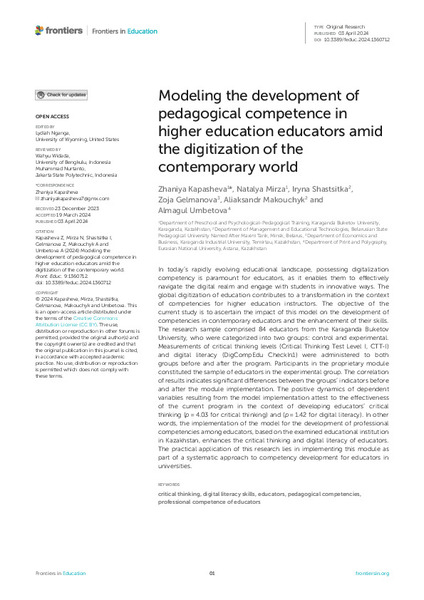
| dc.description.abstract | n today’s rapidly evolving educational landscape, possessing digitalization competency is paramount for educators, as it enables them to effectively navigate the digital realm and engage with students in innovative ways. The global digitization of education contributes to a transformation in the context of competencies for higher education instructors. The objective of the current study is to ascertain the impact of this model on the development of competencies in contemporary educators and the enhancement of their skills. The research sample comprised 84 educators from the Karaganda Buketov University, who were categorized into two groups: control and experimental. Measurements of critical thinking levels (Critical Thinking Test Level I, CTT-I) and digital literacy (DigCompEdu CheckIn1) were administered to both groups before and after the program. Participants in the proprietary module constituted the sample of educators in the experimental group. The correlation of results indicates significant differences between the groups’ indicators before and after the module implementation. The positive dynamics of dependent variables resulting from the model implementation attest to the effectiveness of the current program in the context of developing educators’ critical thinking (p = 4.03 for critical thinking) and (p = 1.42 for digital literacy). In other words, the implementation of the model for the development of professional competencies among educators, based on the examined educational institution in Kazakhstan, enhances the critical thinking and digital literacy of educators. The practical application of this research lies in implementing this module as part of a systematic approach to competency development for educators in universities. | ru |
| dc.language.iso | en | ru |
| dc.publisher | Frontiers in Education | ru |
| dc.relation.ispartofseries | Volume 9; | |
| dc.subject | critical thinking | ru |
| dc.subject | digital literacy skills | ru |
| dc.subject | educators | ru |
| dc.subject | pedagogical competencies | ru |
| dc.subject | professional competence of educators | ru |
| dc.title | Modeling the development of pedagogical competence in higher education educators amid the digitization of the contemporary world | ru |
| dc.type | Article | ru |
Файлы в этом документе
Данный элемент включен в следующие коллекции
-
Social Sciences[759]