Nepotism in Post-Soviet States: The Quantitative Assessment on SocioDemographic Factors and the Corruption Perceptions Index
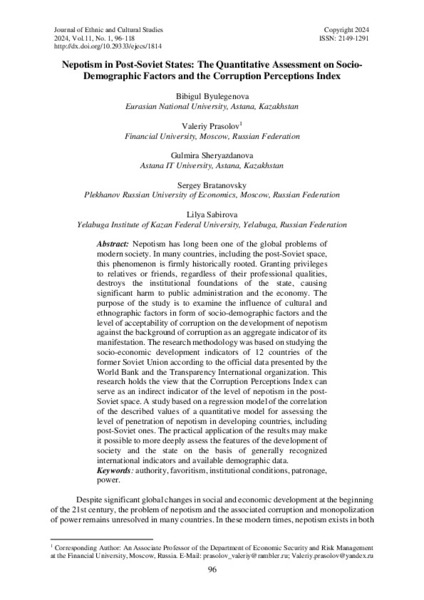
Abstract
Nepotism has long been one of the global problems of
modern society. In many countries, including the post-Soviet space,
this phenomenon is firmly historically rooted. Granting privileges
to relatives or friends, regardless of their professional qualities,
destroys the institutional foundations of the state, causing
significant harm to public administration and the economy. The
purpose of the study is to examine the influence of cultural and
ethnographic factors in form of socio-demographic factors and the
level of acceptability of corruption on the development of nepotism
against the background of corruption as an aggregate indicator of its
manifestation. The research methodology was based on studying the
socio-economic development indicators of 12 countries of the
former Soviet Union according to the official data presented by the
World Bank and the Transparency International organization. This
research holds the view that the Corruption Perceptions Index can
serve as an indirect indicator of the level of nepotism in the postSoviet space. A study based on a regression model of the correlation
of the described values of a quantitative model for assessing the
level of penetration of nepotism in developing countries, including
post-Soviet ones. The practical application of the results may make
it possible to more deeply assess the features of the development of
society and the state on the basis of generally recognized
international indicators and available demographic data.
View/
Collections
- Social Sciences[759]