Religious education in Kazakhstan: Тhe challenges of the COVID-19 pandemic
Date
2021ISSN
25422278xmlui.dri2xhtml.METS-1.0.item-title-alternative
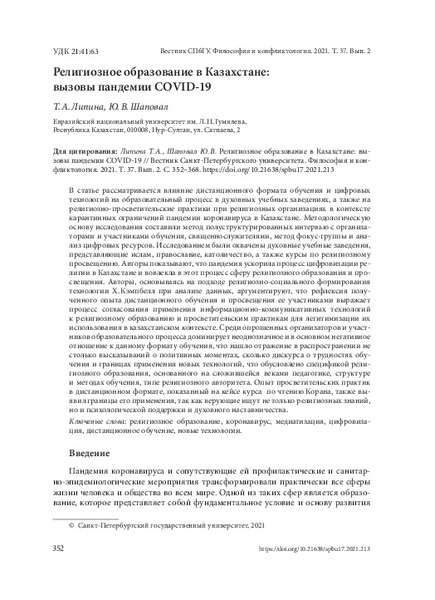
Религиозное образование в Казахстане: вызовы пандемии COVID-19
xmlui.dri2xhtml.METS-1.0.item-identifier-citation
Lipina T.A., Shapoval Yu.V. Religious education in Kazakhstan: The challenges of the COVID-19 pandemic. Vestnik of Saint Petersburg University. Philosophy and Conflict Studies, 2021, vol. 37, issue 2, pp. 352–368. https://doi.org/10.21638/spbu17.2021.213 (In Russian)
Abstract
The article explores the impact of distant learning and digital technologies on the educational process in theological education institutions, as well as on religious and educational practices at religious organizations in the context of the quarantine restrictions of the COVID-19 pandemic in Kazakhstan. The research methodology consisted of semi-structed interviews with organizers and participants of distant learning, clergy, focus group method, and the analysis of digital resources. The study included religious educational institutions representing Islam, Orthodoxy, Catholicism, as well as their religious education for believers. The authors conclude that the pandemic has accelerated the process of digitalization of religion in Kazakhstan, as well as the sphere of religious education. Based on Heidi Campbell’s religious-social shaping approach to technology, the authors claim that the reflection of the experience gained in distance learning by its participants expresses the process of coordinating the application of media technologies to religious education in order to legitimize their use in the Kazakhstani context. The research data reveals an ambiguous and mainly negative attitude toward distance learning among respondents which lead to the spreading of the discourse about the difficulties and limits of using new technologies for religious education with its traditional pedagogy, teaching methods and type of religious authority. The experience of education practices in a distance format illustrated by the case study of the course on reading the Qur’an also revealed the limits of its application, since believers are looking not only for religious knowledge, but also psychological support and spiritual guidance.
View/
Collections
- Social Sciences[759]