
Показать сокращенную информацию
Systematic Review and Results of the Experiment of a Flipped Learning Model for the Courses of Descriptive Geometry, Engineering and Computer Graphics, Computer Geometry
| dc.contributor.author | Voronina, Marianna V. | |
| dc.contributor.author | Moroz, Olga N. | |
| dc.contributor.author | Sudarikov, Alexander E. | |
| dc.contributor.author | Rakhimzhanova, Mira B. | |
| dc.contributor.author | Muratbakeev, Eduard Kh. | |
| dc.date.accessioned | 2024-11-19T05:43:09Z | |
| dc.date.available | 2024-11-19T05:43:09Z | |
| dc.date.issued | 2017 | |
| dc.identifier.issn | 1305-8215 | |
| dc.identifier.other | DOI: 10.12973/eurasia.2017.00967a | |
| dc.identifier.uri | http://rep.enu.kz/handle/enu/18878 | |
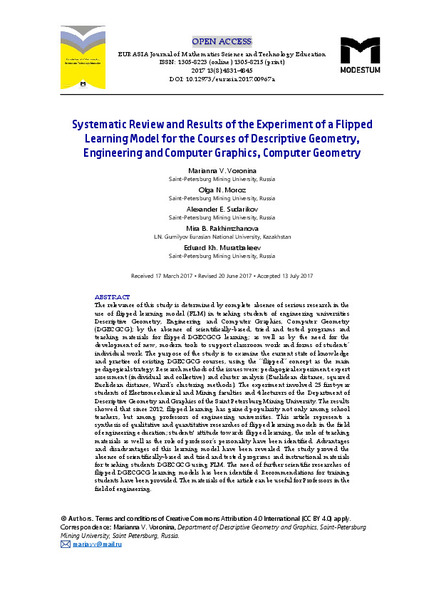
| dc.description.abstract | The relevance of this study is determined by complete absence of serious research in the use of flipped learning model (FLM) in teaching students of engineering universities Descriptive Geometry, Engineering and Computer Graphics, Computer Geometry (DGECGCG); by the absence of scientifically-based, tried and tested programs and teaching materials for flipped DGECGCG learning; as well as by the need for the development of new, modern tools to support classroom work and forms of students’ individual work. The purpose of the study is to examine the current state of knowledge and practice of existing DGECGCG courses, using the “flipped” concept as the main pedagogical strategy. Research methods of the issues were: pedagogical experiment, expert assessment (individual and collective) and cluster analysis (Euclidean distance, squared Euclidean distance, Ward’s clustering methods). The experiment involved 25 first-year students of Electromechanical and Mining faculties and 4 lecturers of the Department of Descriptive Geometry and Graphics of the Saint Petersburg Mining University. The results showed that since 2012, flipped learning has gained popularity not only among school teachers, but among professors of engineering universities. This article represents a synthesis of qualitative and quantitative researches of flipped learning models in the field of engineering education; students' attitude towards flipped learning, the role of teaching materials as well as the role of professor’s personality have been identified. Advantages and disadvantages of this learning model have been revealed. The study proved the absence of scientifically-based and tried and tested programs and instructional materials for teaching students DGECGCG using FLM. The need of further scientific researches of flipped DGECGCG learning models has been identified. Recommendations for training students have been provided. The materials of the article can be useful for Professors in the field of engineering. | ru |
| dc.language.iso | en | ru |
| dc.publisher | EURASIA Journal of Mathematics Science and Technology Education | ru |
| dc.relation.ispartofseries | 13(8):4831-4845; | |
| dc.subject | descriptive geometry | ru |
| dc.subject | engineering and computer graphics | ru |
| dc.subject | computer geometry (DGECGCG) | ru |
| dc.subject | flipped (inverted) learning model (FLM) | ru |
| dc.subject | teaching materials | ru |
| dc.subject | science | ru |
| dc.subject | technology | ru |
| dc.subject | engineering and mathematics programs (STEM) | ru |
| dc.title | Systematic Review and Results of the Experiment of a Flipped Learning Model for the Courses of Descriptive Geometry, Engineering and Computer Graphics, Computer Geometry | ru |
| dc.type | Article | ru |
Файлы в этом документе
Данный элемент включен в следующие коллекции
-
Social Sciences[759]