
Показать сокращенную информацию
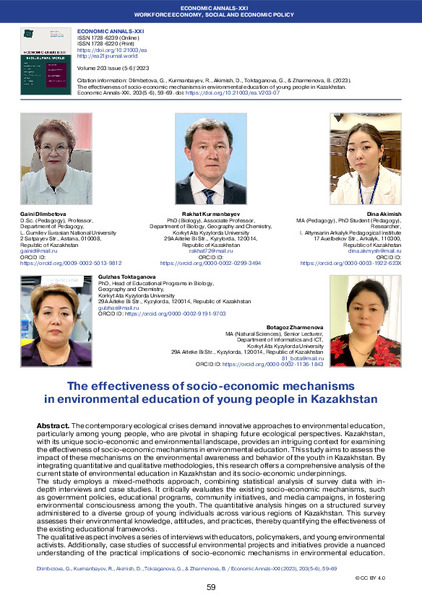
The effectiveness of socio-economic mechanisms in environmental education of young people in Kazakhstan
| dc.contributor.author | Dlimbetova, Gaini | |
| dc.contributor.author | Kurmanbayev, Rakhat | |
| dc.contributor.author | Akimish, Dina | |
| dc.contributor.author | Toktaganova, Gulzhas | |
| dc.contributor.author | Zharmenova, Botagoz | |
| dc.date.accessioned | 2024-11-19T11:36:47Z | |
| dc.date.available | 2024-11-19T11:36:47Z | |
| dc.date.issued | 2023 | |
| dc.identifier.issn | 1728-6239 | |
| dc.identifier.other | doi.org/10.21003/ea.V203-07 | |
| dc.identifier.uri | http://rep.enu.kz/handle/enu/18967 | |
| dc.description.abstract | The contemporary ecological crises demand innovative approaches to environmental education, particularly among young people, who are pivotal in shaping future ecological perspectives. Kazakhstan, with its unique socio-economic and environmental landscape, provides an intriguing context for examining the effectiveness of socio-economic mechanisms in environmental education. This study aims to assess the impact of these mechanisms on the environmental awareness and behavior of the youth in Kazakhstan. By integrating quantitative and qualitative methodologies, this research offers a comprehensive analysis of the current state of environmental education in Kazakhstan and its socio-economic underpinnings. The study employs a mixed-methods approach, combining statistical analysis of survey data with indepth interviews and case studies. It critically evaluates the existing socio-economic mechanisms, such as government policies, educational programs, community initiatives, and media campaigns, in fostering environmental consciousness among the youth. The quantitative analysis hinges on a structured survey administered to a diverse group of young individuals across various regions of Kazakhstan. This survey assesses their environmental knowledge, attitudes, and practices, thereby quantifying the effectiveness of the existing educational frameworks. The qualitative aspect involves a series of interviews with educators, policymakers, and young environmental activists. Additionally, case studies of successful environmental projects and initiatives provide a nuanced understanding of the practical implications of socio-economic mechanisms in environmental education. These methodologies synergize to unveil the multifaceted dynamics of environmental education in the context of Kazakhstan’s socio-economic environment. Results reveal a complex interplay between socioeconomic factors and environmental education efficacy. The findings underscore the significance of culturally and contextually relevant educational materials, the role of socio-economic incentives, and the impact of participatory and community-based approaches in enhancing environmental awareness among the youth. This study also identifies gaps in the current system and proposes strategic improvements. In terms of scientific novelty, this research contributes to the growing body of literature on environmental education by providing empirical evidence from a Kazakhstani perspective. It bridges the gap between socio-economic studies and environmental education, offering insights into how economic and social policies can be leveraged to strengthen environmental education. The practical significance of this study lies in its potential to guide policymakers, educators, and environmental organizations in designing and implementing more effective environmental education programs. By highlighting the socio-economic determinants of successful environmental education, this research paves the way for more targeted and impactful educational strategies in Kazakhstan and similar contexts globally. | ru |
| dc.language.iso | en | ru |
| dc.publisher | ECONOMIC ANNALS-XXI | ru |
| dc.relation.ispartofseries | Volume 203 Issue (5-6)’2023; | |
| dc.subject | Environmental Education | ru |
| dc.subject | Kazakhstan | ru |
| dc.subject | Socio-Economic Mechanisms | ru |
| dc.subject | Youth Engagement | ru |
| dc.subject | MixedMethods Research | ru |
| dc.subject | Policy Analysis | ru |
| dc.subject | Cultural Relevance | ru |
| dc.subject | Community Initiatives | ru |
| dc.subject | Environmental Awareness JEL Classifications | ru |
| dc.subject | Q56 | ru |
| dc.subject | I21 | ru |
| dc.subject | O15 | ru |
| dc.subject | Z18 | ru |
| dc.title | The effectiveness of socio-economic mechanisms in environmental education of young people in Kazakhstan | ru |
| dc.type | Article | ru |
Файлы в этом документе
Данный элемент включен в следующие коллекции
-
Social Sciences[759]