
Показать сокращенную информацию
ANALYSIS OF THE SPECTRAL PROPERTIES OF WHEAT GROWTH IN DIFFERENT VEGETATION PERIODS
| dc.contributor.author | Yerzhanova, A. | |
| dc.contributor.author | Kassymova, A. | |
| dc.contributor.author | Abdikerimova, G. | |
| dc.contributor.author | Abdimomynova, M. | |
| dc.contributor.author | Tashenova, Z. | |
| dc.contributor.author | Nurlybaeva, E. | |
| dc.date.accessioned | 2024-12-06T04:41:56Z | |
| dc.date.available | 2024-12-06T04:41:56Z | |
| dc.date.issued | 2021 | |
| dc.identifier.citation | Yerzhanova, A., Kassymova, A., Abdikerimova, G., Abdimomynova, M., Tashenova, Z., Nurlybaeva, E. (2021). Management of processes of technological transformation of food industry in the formation of sustainable development of agroecosystems. Eastern-European Journal of Enterprise Technologies, 6 (2 (114)), 96–102. doi: https://doi.org/10.15587/1729-4061.2021.249278 | ru |
| dc.identifier.issn | 1729-3774 | |
| dc.identifier.other | DOI: 10.15587/1729-4061.2021.249278 | |
| dc.identifier.uri | http://rep.enu.kz/handle/enu/19915 | |
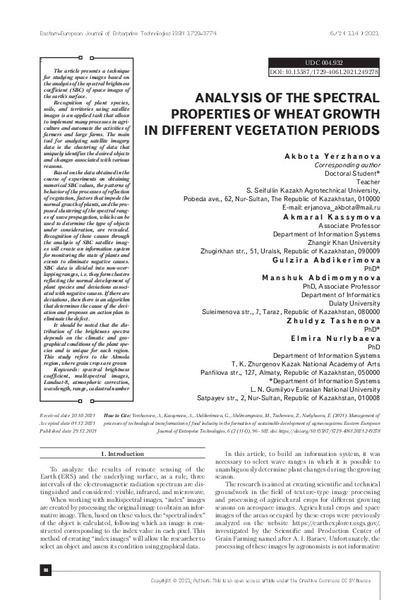
| dc.description.abstract | The article presents a technique for studying space images based on the analysis of the spectral brightness coefficient (SBC) of space images of the earth's surface. Recognition of plant species, soils, and territories using satellite images is an applied task that allows to implement many processes in agriculture and automate the activities of farmers and large farms. The main tool for analyzing satellite imagery data is the clustering of data that uniquely identifies the desired objects and changes associated with various reasons. Based on the data obtained in the course of experiments on obtaining numerical SBC values, the patterns of behavior of the processes of reflection of vegetation, factors that impede the normal growth of plants, and the proposed clustering of the spectral ranges of wave propagation, which can be used to determine the type of objects under consideration, are revealed. Recognition of these causes through the analysis of SBC satellite images will create an information system for monitoring the state of plants and events to eliminate negative causes. SBC data is divided into non-overlapping ranges, i.e. they form clusters reflecting the normal development of plant species and deviations associated with negative causes. If there are deviations, then there is an algorithm that determines the cause of the deviation and proposes an action plan to eliminate the defect. It should be noted that the distribution of the brightness spectra depends on the climatic and geographical conditions of the plant species and is unique for each region. This study refers to the Akmola region, where grain crops are grown | ru |
| dc.language.iso | en | ru |
| dc.publisher | Eastern-European Journal of Enterprise Technologies | ru |
| dc.relation.ispartofseries | 6 (2 (114)), 96–102; | |
| dc.subject | spectral brightness coefficient | ru |
| dc.subject | multispectral images | ru |
| dc.subject | Landsat-8 | ru |
| dc.subject | atmospheric correction | ru |
| dc.subject | wavelength | ru |
| dc.subject | range | ru |
| dc.subject | cadastral number | ru |
| dc.title | ANALYSIS OF THE SPECTRAL PROPERTIES OF WHEAT GROWTH IN DIFFERENT VEGETATION PERIODS | ru |
| dc.type | Article | ru |
Файлы в этом документе
Данный элемент включен в следующие коллекции
-
Engineering[651]