
Показать сокращенную информацию
DESIGN AND RESEARCH OF THE BEHAVIORAL MODEL FOR THE MODULAR REDUCTION DEVICE
| dc.contributor.author | Aitkhozhayeva, Y.Zh. | |
| dc.contributor.author | Tynymbayev, S. | |
| dc.contributor.author | Adilbekkyzy, S. | |
| dc.contributor.author | Skabylov, A. | |
| dc.contributor.author | Ibraimov, M. | |
| dc.date.accessioned | 2024-12-10T04:27:02Z | |
| dc.date.available | 2024-12-10T04:27:02Z | |
| dc.date.issued | 2020 | |
| dc.identifier.issn | 1811-1165 | |
| dc.identifier.other | DOI 10.31489/2020No1/151-156 UDC: 621.38.049.77 DESIGN AND RESEARCH OF THE BEHAVIORAL MODEL FOR THE MODULAR REDUCTION DEVICE Aitkhozhayeva Y.Zh.1 , Tynymbayev S. 2 , Adilbekkyzy S. 3 , Skabylov A. 4* , Ibraimov M.4 1 K.I. Satbayev Kazakh National Research Technical University, Almaty, Kaz | |
| dc.identifier.uri | http://rep.enu.kz/handle/enu/19975 | |
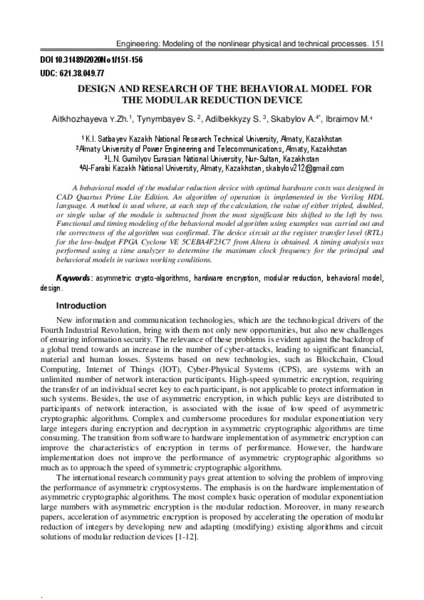
| dc.description.abstract | A behavioral model of the modular reduction device with optimal hardware costs was designed in CAD Quartus Prime Lite Edition. An algorithm of operation is implemented in the Verilog HDL language. A method is used where, at each step of the calculation, the value of either tripled, doubled, or single value of the module is subtracted from the most significant bits shifted to the left by two. Functional and timing modeling of the behavioral model algorithm using examples was carried out and the correctness of the algorithm was confirmed. The device circuit at the register transfer level (RTL) for the low-budget FPGA Cyclone VE 5CEBA4F23C7 from Altera is obtained. A timing analysis was performed using a time analyzer to determine the maximum clock frequency for the principal and behavioral models in various working conditions. | ru |
| dc.language.iso | en | ru |
| dc.publisher | Eurasian Physical Technical Journal | ru |
| dc.relation.ispartofseries | Vol.17, No.1(33); | |
| dc.subject | asymmetric crypto-algorithms | ru |
| dc.subject | hardware encryption | ru |
| dc.subject | modular reduction | ru |
| dc.subject | behavioral model | ru |
| dc.subject | design | ru |
| dc.title | DESIGN AND RESEARCH OF THE BEHAVIORAL MODEL FOR THE MODULAR REDUCTION DEVICE | ru |
| dc.type | Article | ru |
Файлы в этом документе
Данный элемент включен в следующие коллекции
-
Engineering[651]