Показать сокращенную информацию
Introducing Blended Learning in foreign language teaching
| dc.contributor.author | Tugayeva, D.B. | |
| dc.contributor.author | Nurzhanova, Zh.D. | |
| dc.contributor.author | Dukembay, G.N. | |
| dc.date.accessioned | 2023-06-29T06:38:51Z | |
| dc.date.available | 2023-06-29T06:38:51Z | |
| dc.date.issued | 2021 | |
| dc.identifier.issn | 2616-6895 | |
| dc.identifier.uri | http://rep.enu.kz/handle/enu/3146 | |
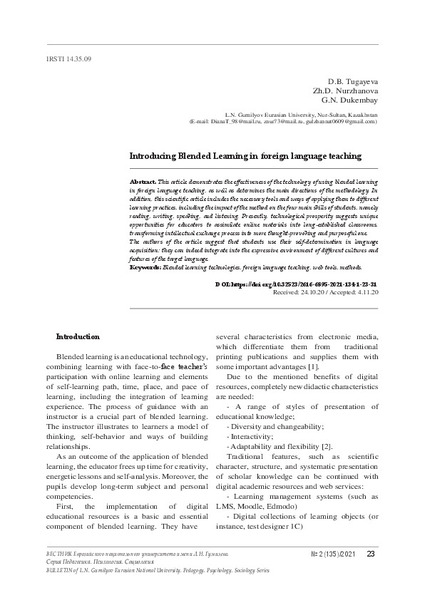
| dc.description.abstract | This article demonstrates the effectiveness of the technology of using blended learning in foreign language teaching, as well as determines the main directions of the methodology. In addition, this scientific article includes the necessary tools and ways of applying them to different learning practices, including the impact of the method on the four main skills of students, namely reading, writing, speaking, and listening. Presently, technological prosperity suggests unique opportunities for educators to assimilate online materials into long-established classrooms, transforming intellectual exchange process into more thought-provoking and purposeful one. The authors of the article suggest that students use their self-determination in language acquisition: they can indeed integrate into the expressive environment of different cultures and features of the target language. | ru |
| dc.language.iso | en | ru |
| dc.publisher | L.N.Gumilyov Eurasian National University | ru |
| dc.subject | Blended learning technologies | ru |
| dc.subject | foreign language teaching | ru |
| dc.subject | web tools | ru |
| dc.subject | methods | ru |
| dc.title | Introducing Blended Learning in foreign language teaching | ru |
| dc.type | Article | ru |