Показать сокращенную информацию
Analysis of the current state of problem loans in second-tier banks
| dc.contributor.author | Rakhimzhanova, K.K. | |
| dc.contributor.author | Makhysh, S.B. | |
| dc.date.accessioned | 2023-08-23T04:25:49Z | |
| dc.date.available | 2023-08-23T04:25:49Z | |
| dc.date.issued | 2020 | |
| dc.identifier.issn | 2079-620Х | |
| dc.identifier.uri | http://rep.enu.kz/handle/enu/5396 | |
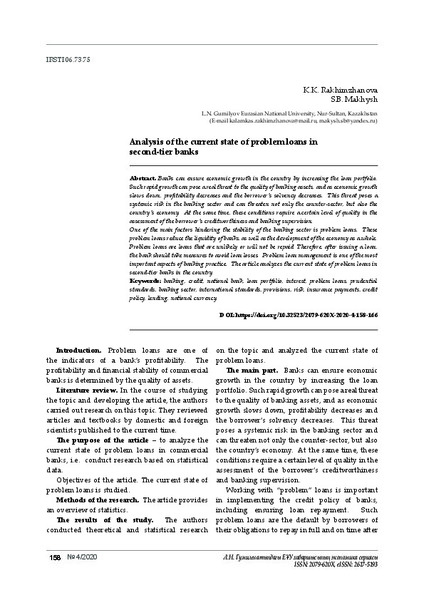
| dc.description.abstract | Banks can ensure economic growth in the country by increasing the loan portfolio. Such rapid growth can pose a real threat to the quality of banking assets, and as economic growth slows down, profitability decreases and the borrower’s solvency decreases. This threat poses a systemic risk in the banking sector and can threaten not only the counter-sector, but also the country’s economy. At the same time, these conditions require a certain level of quality in the assessment of the borrower’s creditworthiness and banking supervision. One of the main factors hindering the stability of the banking sector is problem loans. These problem loans reduce the liquidity of banks, as well as the development of the economy as a whole. Problem loans are loans that are unlikely or will not be repaid. Therefore, after issuing a loan, the bank should take measures to avoid loan losses. Problem loan management is one of the most important aspects of banking practice. The article analyzes the current state of problem loans in second-tier banks in the country. | ru |
| dc.language.iso | en | ru |
| dc.publisher | L.N.Gumilyov Eurasian National University | ru |
| dc.subject | banking | ru |
| dc.subject | credit | ru |
| dc.subject | national bank | ru |
| dc.subject | loan portfolio | ru |
| dc.subject | interest | ru |
| dc.subject | problem loans | ru |
| dc.subject | prudential standards | ru |
| dc.subject | banking sector | ru |
| dc.subject | international standards | ru |
| dc.subject | provisions | ru |
| dc.subject | risk | ru |
| dc.subject | insurance payments | ru |
| dc.subject | credit policy | ru |
| dc.subject | lending | ru |
| dc.subject | national currency | ru |
| dc.title | Analysis of the current state of problem loans in second-tier banks | ru |
| dc.type | Article | ru |