
Показать сокращенную информацию
PHARMACEUTICAL FUNGICIDE IN THE AQUATIC ENVIRONMENT: DEVELOPMENT OF PREDICTED ENVIRONMENTAL CONCENTRATION OF TERBINAFINE IN RIVERS
| dc.contributor.author | Beisembinova, Aiziya Umirzhankyzy | |
| dc.date.accessioned | 2023-10-19T11:28:39Z | |
| dc.date.available | 2023-10-19T11:28:39Z | |
| dc.date.issued | 2020-04-10 | |
| dc.identifier.isbn | 978-601-337-318-8 | |
| dc.identifier.uri | http://rep.enu.kz/handle/enu/8858 | |
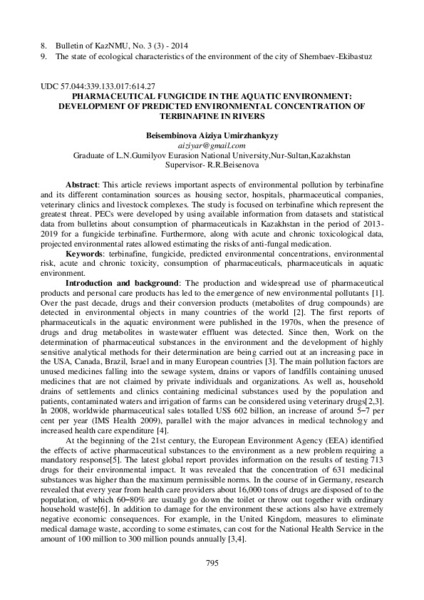
| dc.description.abstract | This article reviews important aspects of environmental pollution by terbinafine and its different contamination sources as housing sector, hospitals, pharmaceutical companies, veterinary clinics and livestock complexes. The study is focused on terbinafine which represent the greatest threat. PECs were developed by using available information from datasets and statistical data from bulletins about consumption of pharmaceuticals in Kazakhstan in the period of 2013-2019 for a fungicide terbinafine. Furthermore, along with acute and chronic toxicological data, projected environmental rates allowed estimating the risks of anti-fungal medication. | ru |
| dc.language.iso | en | ru |
| dc.publisher | L.N.Gumilyov Eurasian National University | ru |
| dc.subject | terbinafine | ru |
| dc.subject | fungicide | ru |
| dc.subject | predicted environmental concentrations | ru |
| dc.subject | environmental risk | ru |
| dc.subject | acute and chronic toxicity | ru |
| dc.subject | consumption of pharmaceuticals | ru |
| dc.subject | pharmaceuticals in aquatic environment | ru |
| dc.title | PHARMACEUTICAL FUNGICIDE IN THE AQUATIC ENVIRONMENT: DEVELOPMENT OF PREDICTED ENVIRONMENTAL CONCENTRATION OF TERBINAFINE IN RIVERS | ru |
| dc.type | Article | ru |
Файлы в этом документе
Данный элемент включен в следующие коллекции
-
Естественные науки[112]