Показать сокращенную информацию
A comprehensive parametrization approach for the Hubble parameter in scalar field dark energy models
| dc.contributor.author | Koussour, M. | |
| dc.contributor.author | Myrzakulov, N. | |
| dc.contributor.author | Myrzakulova, S. | |
| dc.contributor.author | Sofuoğlu, D. | |
| dc.date.accessioned | 2025-01-08T07:47:38Z | |
| dc.date.available | 2025-01-08T07:47:38Z | |
| dc.date.issued | 2023 | |
| dc.identifier.issn | 2211-3797 | |
| dc.identifier.other | doi.org/10.1016/j.rinp.2023.107166 | |
| dc.identifier.uri | http://rep.enu.kz/handle/enu/20708 | |
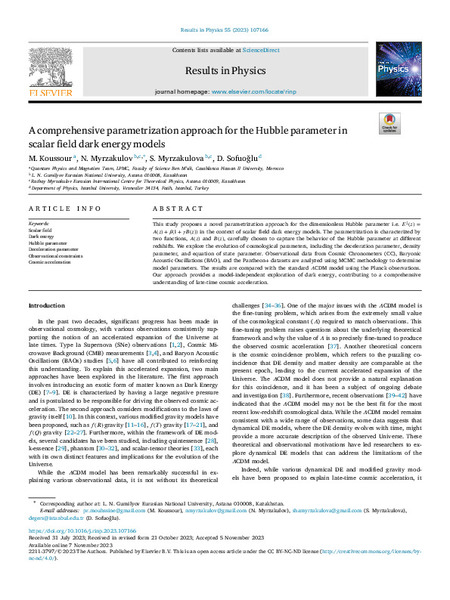
| dc.description.abstract | This study proposes a novel parametrization approach for the dimensionless Hubble parameter i.e. 𝐸2 (𝑧) = 𝐴(𝑧) + 𝛽(1 + 𝛾𝐵(𝑧)) in the context of scalar field dark energy models. The parametrization is characterized by two functions, 𝐴(𝑧) and 𝐵(𝑧), carefully chosen to capture the behavior of the Hubble parameter at different redshifts. We explore the evolution of cosmological parameters, including the deceleration parameter, density parameter, and equation of state parameter. Observational data from Cosmic Chronometers (CC), Baryonic Acoustic Oscillations (BAO), and the Pantheon+ datasets are analyzed using MCMC methodology to determine model parameters. The results are compared with the standard 𝛬CDM model using the Planck observations. Our approach provides a model-independent exploration of dark energy, contributing to a comprehensive understanding of late-time cosmic acceleration. | ru |
| dc.language.iso | en | ru |
| dc.publisher | Results in Physics | ru |
| dc.relation.ispartofseries | 55 (2023) 107166; | |
| dc.subject | Scalar field | ru |
| dc.subject | Dark energy | ru |
| dc.subject | Hubble parameter | ru |
| dc.subject | Deceleration parameter | ru |
| dc.subject | Observational constraints | ru |
| dc.subject | Cosmic acceleration | ru |
| dc.title | A comprehensive parametrization approach for the Hubble parameter in scalar field dark energy models | ru |
| dc.type | Article | ru |