Показать сокращенную информацию
Structural, Dielectric, and Mechanical Properties of High-Content Cubic Zirconia Ceramics Obtained via Solid-State Synthesis
| dc.contributor.author | Giniyatova, Sholpan G. | |
| dc.contributor.author | Kozlovskiy, Artem L. | |
| dc.contributor.author | Shakirzyanov, Rafael I. | |
| dc.contributor.author | Volodina, Natalia O. | |
| dc.contributor.author | Shlimas, Dmitriy I. | |
| dc.contributor.author | Borgekov, Daryn B. | |
| dc.date.accessioned | 2025-01-09T10:01:52Z | |
| dc.date.available | 2025-01-09T10:01:52Z | |
| dc.date.issued | 2023 | |
| dc.identifier.citation | Giniyatova, S.G.; Kozlovskiy, A.L.; Shakirzyanov, R.I.; Volodina, N.O.; Shlimas, D.I.; Borgekov, D.B. Structural, Dielectric, and Mechanical Properties of High-Content Cubic Zirconia Ceramics Obtained via Solid-State Synthesis. Appl. Sci. 2023, 13, 10989. https://doi.org/10.3390/ app131910989 | ru |
| dc.identifier.issn | 2162-5689 | |
| dc.identifier.other | doi.org/10.3390/ app131910989 | |
| dc.identifier.uri | http://rep.enu.kz/handle/enu/20774 | |
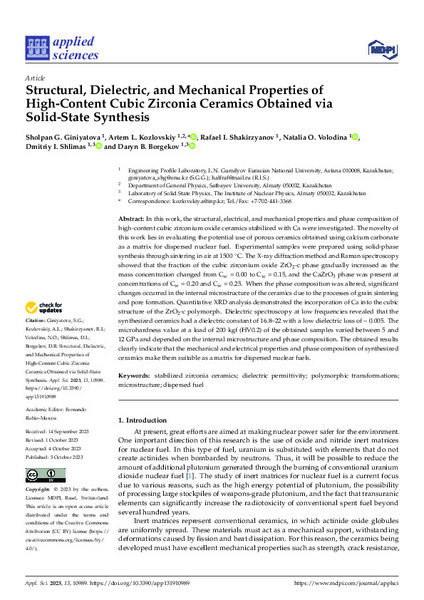
| dc.description.abstract | In this work, the structural, electrical, and mechanical properties and phase composition of high-content cubic zirconium oxide ceramics stabilized with Ca were investigated. The novelty of this work lies in evaluating the potential use of porous ceramics obtained using calcium carbonate as a matrix for dispersed nuclear fuel. Experimental samples were prepared using solid-phase synthesis through sintering in air at 1500 ◦C. The X-ray diffraction method and Raman spectroscopy showed that the fraction of the cubic zirconium oxide ZrO2 -c phase gradually increased as the mass concentration changed from Cw = 0.00 to Cw = 0.15, and the CaZrO3 phase was present at concentrations of Cw = 0.20 and Cw = 0.25. When the phase composition was altered, significant changes occurred in the internal microstructure of the ceramics due to the processes of grain sintering and pore formation. Quantitative XRD analysis demonstrated the incorporation of Ca into the cubic structure of the ZrO2 -c polymorph. Dielectric spectroscopy at low frequencies revealed that the synthesized ceramics had a dielectric constant of 16.8–22 with a low dielectric loss of ~ 0.005. The microhardness value at a load of 200 kgf (HV0.2) of the obtained samples varied between 5 and 12 GPa and depended on the internal microstructure and phase composition. The obtained results clearly indicate that the mechanical and electrical properties and phase composition of synthesized ceramics make them suitable as a matrix for dispersed nuclear fuels. | ru |
| dc.language.iso | en | ru |
| dc.publisher | Applied Sciences | ru |
| dc.relation.ispartofseries | 13, 10989; | |
| dc.subject | stabilized zirconia ceramics | ru |
| dc.subject | dielectric permittivity | ru |
| dc.subject | polymorphic transformations | ru |
| dc.subject | microstructure | ru |
| dc.subject | dispersed fuel | ru |
| dc.title | Structural, Dielectric, and Mechanical Properties of High-Content Cubic Zirconia Ceramics Obtained via Solid-State Synthesis | ru |
| dc.type | Article | ru |