Показать сокращенную информацию
Characterization of iron oxide waste scales obtained by rolling mill steel industry
| dc.contributor.author | Kargin, J. | |
| dc.contributor.author | Valladares, L. De Los Santos | |
| dc.contributor.author | Borja‑Castro, L. E. | |
| dc.contributor.author | Xize, Jiang | |
| dc.contributor.author | Mukhambetov, D. G. | |
| dc.contributor.author | Konyukhov, Y. V. | |
| dc.contributor.author | Moreno, N. O. | |
| dc.contributor.author | Bustamante Dominguez, A. G. | |
| dc.contributor.author | Barnes, C. H. W. | |
| dc.date.accessioned | 2025-01-10T06:23:12Z | |
| dc.date.available | 2025-01-10T06:23:12Z | |
| dc.date.issued | 2022 | |
| dc.identifier.issn | 0304-3843 | |
| dc.identifier.other | doi.org/10.1007/s10751-022-01800-7 | |
| dc.identifier.uri | http://rep.enu.kz/handle/enu/20794 | |
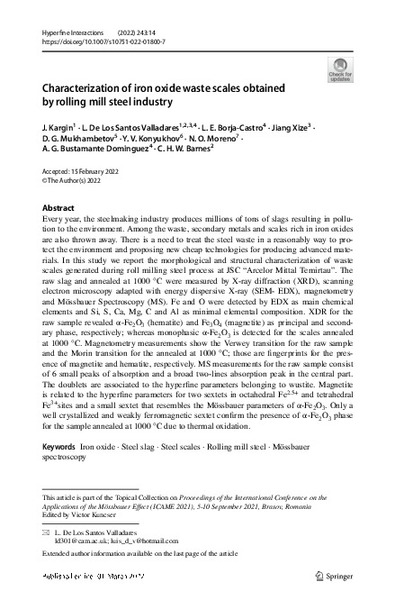
| dc.description.abstract | Every year, the steelmaking industry produces millions of tons of slags resulting in pollution to the environment. Among the waste, secondary metals and scales rich in iron oxides are also thrown away. There is a need to treat the steel waste in a reasonably way to protect the environment and proposing new cheap technologies for producing advanced materials. In this study we report the morphological and structural characterization of waste scales generated during roll milling steel process at JSC “Arcelor Mittal Temirtau”. The raw slag and annealed at 1000 °C were measured by X-ray difraction (XRD), scanning electron microscopy adapted with energy dispersive X-ray (SEM- EDX), magnetometry and Mössbauer Spectroscopy (MS). Fe and O were detected by EDX as main chemical elements and Si, S, Ca, Mg, C and Al as minimal elemental composition. XDR for the raw sample revealed α-Fe2O3 (hematite) and Fe3O4 (magnetite) as principal and secondary phase, respectively; whereas monophasic α-Fe2O3 is detected for the scales annealed at 1000 °C. Magnetometry measurements show the Verwey transition for the raw sample and the Morin transition for the annealed at 1000 °C; those are fngerprints for the presence of magnetite and hematite, respectively. MS measurements for the raw sample consist of 6 small peaks of absorption and a broad two-lines absorption peak in the central part. The doublets are associated to the hyperfne parameters belonging to wustite. Magnetite is related to the hyperfne parameters for two sextets in octahedral Fe2.5+ and tetrahedral Fe3+sites and a small sextet that resembles the Mössbauer parameters of α-Fe2O3. Only a well crystallized and weakly ferromagnetic sextet confrm the presence of α-Fe2O3 phase for the sample annealed at 1000 °C due to thermal oxidation. | ru |
| dc.language.iso | en | ru |
| dc.publisher | Hyperfine Interactions | ru |
| dc.subject | Iron oxide | ru |
| dc.subject | Steel slag | ru |
| dc.subject | Steel scales | ru |
| dc.subject | Rolling mill steel | ru |
| dc.subject | Mössbauer spectroscopy | ru |
| dc.title | Characterization of iron oxide waste scales obtained by rolling mill steel industry | ru |
| dc.type | Article | ru |