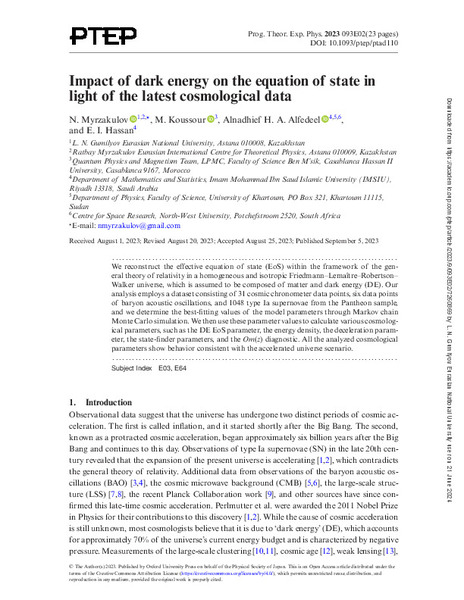
| dc.description.abstract | We reconstruct the effective equation of state (EoS) within the framework of the general theory of relativity in a homogeneous and isotropic Friedmann–Lemaître–Robertson–
Walker universe, which is assumed to be composed of matter and dark energy (DE). Our
analysis employs a dataset consisting of 31 cosmic chronometer data points, six data points
of baryon acoustic oscillations, and 1048 type Ia supernovae from the Pantheon sample,
and we determine the best-fitting values of the model parameters through Markov chain
Monte Carlo simulation. We then use these parameter valuesto calculate various cosmological parameters, such as the DE EoS parameter, the energy density, the deceleration parameter, the state-finder parameters, and the Om(z) diagnostic. All the analyzed cosmological
parameters show behavior consistent with the accelerated universe scenario. | ru |